Blog
About
Indices
Films by Title Gateway Cinephile Posts by Date The Take-Up and Other Posts by Date Horror Cinema David Lynch's Shorts John Ford's Silents H. P. Lovecraft Adaptations Twin Peaks: The Return Westworld Freeze Frame Archive
What I Read

Gateway Cinephile

Appreciation and Criticism of Cinema Through Heartland Eyes
Blog
About
Indices
Films by Title Gateway Cinephile Posts by Date The Take-Up and Other Posts by Date Horror Cinema David Lynch's Shorts John Ford's Silents H. P. Lovecraft Adaptations Twin Peaks: The Return Westworld Freeze Frame Archive
What I Read
Elena and Her Men

Elena and Her Men

2014 Classic French Film Festival: Elena and Her Men

[This introduction to Jean Renoir's Elena and Her Men was presented on June 22, 2014 at the St. Louis Art Museum as a part of the 2014 Classic French Film Festival.]

Jean Renoir's 1956 feature Elena and Her Men is rarely cited as one of the director's more enduring cinematic accomplishments. Critics have even labeled it with that dreaded adjective, “lesser".  As in: “Elena is lesser Renoir.” Certainly, the film falls at the later and less well-regarded end of the director's filmography. Renoir had spent most of the 1940s making films in Hollywood, which had been a somewhat disillusioning experience for him. He subsequently traveled to India to shoot his first color film, The River, before returning to Europe in the early 1950s. There he helmed three features in succession: The Golden Coach, French Cancan, and Elena and Her Men. All three were luscious Technicolor productions that blended light comedy, romance, and music. None of them were especially loved in their time by audiences or critics—with the notable exception of nascent French New Wave figures such as François Truffaut and Jean-Luc Godard. Elena and Her Men in particular was dismissed when it premiered in Paris in September of 1956, and then in the U.S. in the following March under the suggestive English title Paris Does Strange Things. The contemporary New York Times review decried the film as a “bewildering” “fiasco” with “horrible acting”. With all due respect to the late great Times critic and professional curmudgeon Bosley Crowther, he was just plain wrong about Elena.

Jean Renoir was always a reflective and self-effacing artist, and he freely admitted after the fact that his primary motivation for making Elena had been the opportunity to work with iconic Swedish performer Ingrid Bergman. At the time, the actress was near the end of her self-imposed exile in Europe, a situation necessitated by American outrage over her affair with and then marriage to Italian director Roberto Rossellini. Bergman had not previously portrayed the lead in a comedic feature, and Elena demonstrates that Renoir understood how to utilize the actress' world-renowned glamour (and sexual notoriety) as a farcical building block.

Her character, Elena, is a Polish noblewoman of dwindling means, dwelling in a turn-of-the-century France that is ripe with nationalist sentiment. Strong-willed but fickle, romantic but ambitious, Elena is the shimmering star around which a cluster of love-besotted men orbit. These suitors collide and careen off one another, creating ripples in the French political order and along armed European borders. The white daisy that Elena bestows as a good luck charm multiplies as the film goes on, marking the lapels of soldiers, supplicants, and spin doctors like a telltale thumbprint. The flower seems to say, “Elena Was Here”. However, the woman herself remains an enigma. Elena's motivations are obscure and contradictory: she seems to relish the pragmatic power that her beauty and charm afford, but also craves the pure, poetic love of a devoted man.

Foremost among the men that dance on Elena's strings is the guileless General Rollan, portrayed by director Jean Cocteau's dashing muse and partner, Jean Marais. Rollan is loosely based on real-world French officer and politician Georges Ernest Boulanger. A hero of the Franco-Russian War, Boulanger became a populist conservative icon in the late nineteenth century, and was nearly goaded into toppling the Republic in a coup d'état. Renoir and co-writer Jean Serge hastily fictionalized the script out of respect for Boulanger's living descendants, resulting in a film that feels gently rather than viciously satirical. The story's target it not the specific weaknesses of French culture, but the general gullibility of humankind. Leaders rouse the masses with jingoistic pomp, while the leaders themselves are cajoled by scheming lackeys.

In this and other respects, Elena and Her Men shares more than a few features with Shakespeare's comedies. There is the shifting love triangle at the center of the plot, as well as a secondary, more buffoonish romantic rivalry. Like one of the Bard's bawdy farces, the film includes costume swaps and mistaken identities, betrothals and rendezvous, and a tidy yet cynical ending. Elena even features a troupe of traveling performers, in the form of a Roma circus caravan. The Golden Coach, French Cancan, and Elena and Her Men all deal with spectacle and illusion. The earlier films approach these themes through, respectively, the commedia dell'arte and the French café-chantant. Elena's gypsy carnival folk merely underline what is already apparent from the Bastille Day military parade, the sensational newspaper headlines, the hawking street musician, the choreographed dinner party, and the worshipful bordello madam. All point to one truth: everything is a performance for someone's benefit.

PostedJune 22, 2014
AuthorAndrew Wyatt
CategoriesEssays
Enemy

Enemy

Enemy

2013 // Canada / Spain // Denis Villeneuve // March 29, 2014 // Digital Theatrical Projection (St. Louis Cinema Chase Park Plaza)

[Note: This post contains moderate spoilers.]

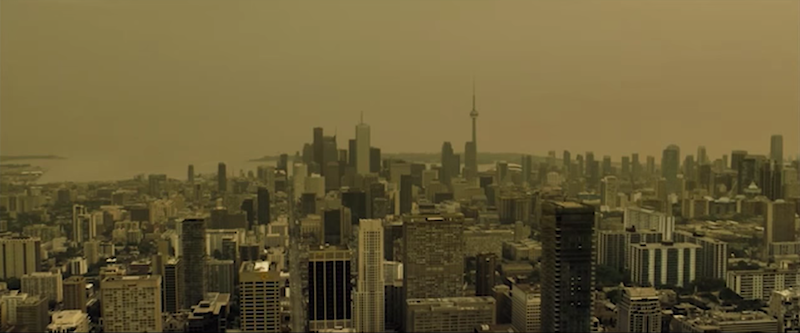
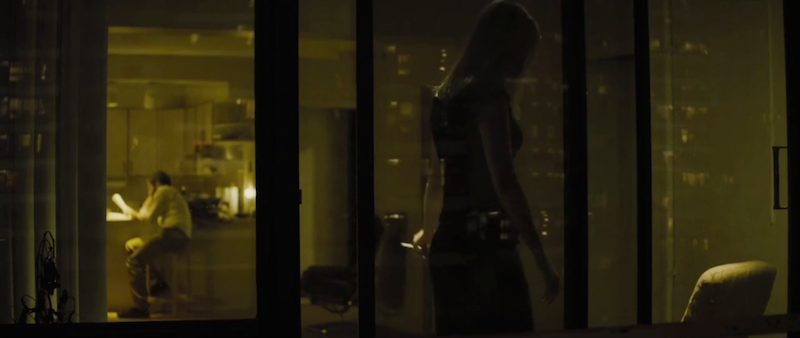
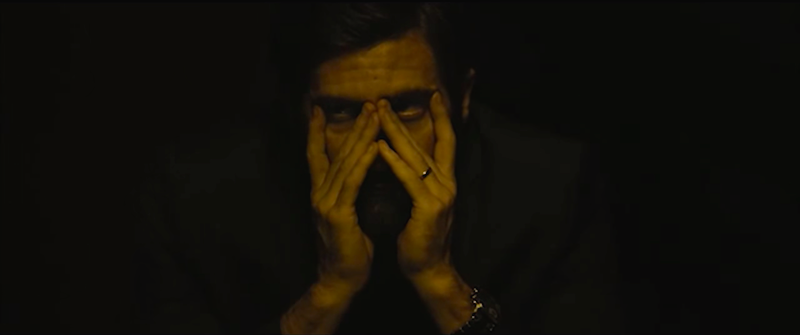
A nauseating yellow pall clings to every inch of Canadian director Denis Villeneuve's horrifically unsettling new feature, Enemy. The hue feels both toxic and suffocating, as though the film’s events were enveloped in a sulfur smog. This sort of domineering color correction has become so commonplace in cinema—witness the triumph of the dreaded orange-and-teal—that it is notable when a film aggressively employs it for a purpose actually related to storytelling. The omnipresent jaundice haze that cloaks Enemy evokes contagion, contamination, and fungal rot. It is the color of bile on a sickbed sheet. It implies a threat, but one that is concealed, like a cancer that reveals itself only through a nagging cough and gnawing fear.

This repulsive tinting is merely one aspect of the film’s style that nurtures a potent and relentless sense of unease. That mood is seeded by the film’s enigmatic and strangely menacing first scene, in which a intense, bearded man (Jake Gyllenhaal) follows a shadowed corridor to a guarded door. Passing the gatekeeper, he enters a dim chamber where an underground sex show is underway. Patrons look on impassively as some sort of outré performance unfolds just offscreen, its erotic character clear but its details indefinite. However, things become startlingly specific when a silver serving tray is produced and then uncovered, revealing an enormous live tarantula. A performer raises a heel and holds it pointedly over the arachnid, while the newly arrived man sits with his head in his hands, peering out in dull fascination and profound self-disgust.

This bizarre opening sequence is always lurking beneath the surface of Enemy. It is a promise that every secret thing will be unearthed in time, lending a touch of fearful expectation to the events that follow. The viewer is next introduced to the sad, shuffling routine of Adam (Gyllenhaal again), a history professor in a nameless city. In a university lecture hall dotted with too-few students, Adam holds forth on the cyclical nature of humanity’s endless struggles. He quotes Marx’s observation, “History repeats itself, first as tragedy, then as farce,” and describes the rise and fall of totalitarian powers. Bread and circuses are key, he notes, to keeping a populace distracted from their diminishing liberties.

Adam seems to be caught in a tedious, conformist loop, the radical flavor of his teachings notwithstanding. He lectures, goes home to his little apartment, grades papers, eats dinner, and has sex with his girlfriend Mary (Melanie Laurent), sometimes vacantly, sometimes desperately. Each day Adam performs the same mundane rituals, and then next day as well, such that time begins to seem jumbled and slippery. Mary appears to be his only human connection, and even that relationship feels weirdly distant and awkward, as if they are both biding their time. During the early hours one night, he attempts to rape her as she slumbers beside him, to her understandable shock and anger. Adam seems as surprised as her.

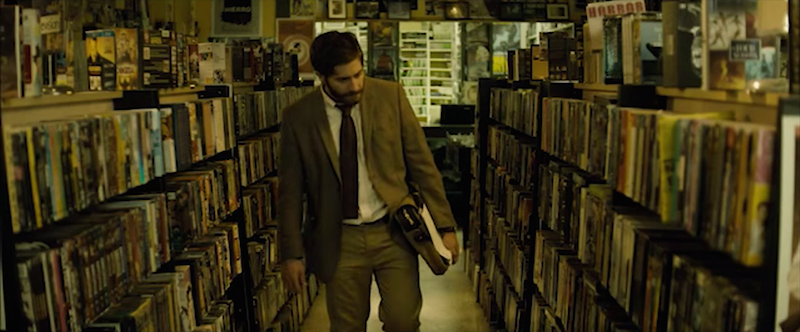
One day, apropos of nothing, a fellow faculty member recommends a movie, and Adam reacts with the dazed awkwardness of a man with only minimal exposure to pop entertainment. He sheepishly seeks out the DVD at a local video store, and while Mary sleeps he watches the film on his laptop, like a teenager clandestinely browsing porn on his mother’s computer. The movie proves banal, until Adam witnesses a sight so strange that he has to rewind and look again: an actor in a bit part who could be his identical twin. The sheer uncanniness of this discovery is the jolt that dislodges Adam from the monotony of his existence. The actor in question, Anthony (also Gyllenhaal), becomes an obsession for Adam, a target for energies that had previously kept the academic moving in listless circles.

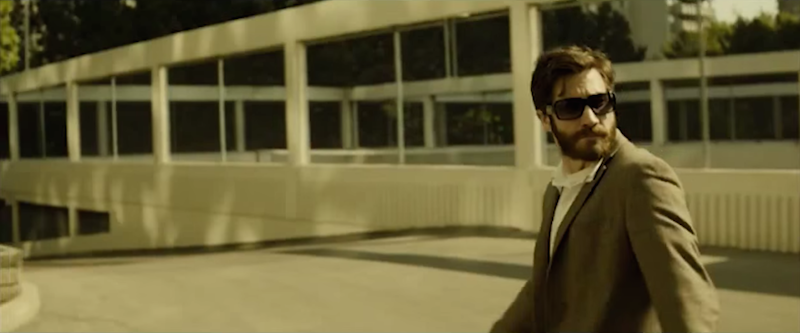
Like an overgrown Hardy Boy, Adam tracks down his doppelganger with some amateur sleuthing. Donning a pair of dime store sunglasses, he bluffs his way into Anthony’s talent agency by impersonating the actor. Eventually he secures the man’s home address and phone number, and is soon lurking outside Anthony’s building, counting off windows in an effort to identify the man’s apartment. Initially, a kind of perturbed curiosity drives Adam to seek out his double. He harbors a vague hope that the man will have the answers that he does not. Adam is vitalized by the thrill of playing detective, recalling Betty’s giddy exhortation in Mulholland Drive: “It'll be just like in the movies. Pretending to be somebody else.” (In his enthusiasm for a mystery, Adam also echoes Gyllenhaal’s Robert Graysmith from Zodiac.) However, when Adam places a fumbling phone call to Anthony’s home, the actor’s pregnant wife Helen (Sarah Gadon) answers and mistakes the professor’s voice for that of her husband. Thereafter, Adam begins to seem increasingly unnerved by the situation. By intruding into his duplicate’s life, he has created a conjunction between their formerly distinct worlds, an overlap that will inevitably result in an upheaval.

Adam and an irritated Anthony eventually speak directly, and their overheard phone call picks at Helen’s suspicions. Anthony tries to reassure her that Adam is just a starstruck weirdo, but she suddenly asks, “Are you lying to me?” (Gadon’s delivery of this line, her eyes narrowing subtly, is downright flawless.) A kind of knowing fearfulness clings to Helen’s reactions. One senses that Anthony has had ample practice at deception, above and beyond what is required for his profession. Without her husband’s knowledge, Helen goes to the university campus and lingers near Adam’s department until she crosses paths with the professor. Instead of identifying herself, Helen can only gape in astonishment at this man who wears her husband’s face. “He looks exactly like you,” she later reports to Anthony, and then pleads, “What’s happening?” “I really don’t know what you’re talking about,” is his baffled reply. In a voice dripping with cold terror, she can only respond, “I think you know.”

Indeed: What is happening? Enemy is remarkably coy about what sort of story it is spinning. The film has the motifs and rhythms of a thriller, certainly, but its essential nature is fiendishly ambiguous. It could be a psychological portrait rendered from an unreliable viewpoint. Or a folk nightmare given a fresh coat of contemporary magical realism. Or an allegory on the insidious qualities of authoritarian control. The source material’s provenance suggests that the latter in particular. Screenwriter Javier Gullón adapted the script from the novel The Double by Portuguese writer and Nobel laureate José Saramago. A communist of libertarian bent, Saramago grew up and dwelled for decades under the boot of his nation’s fascistic Estada Novo government. Unsurprisingly, he often worked pointed political critique between the lines of his darkly absurd stories. While Gullón alters The Double’s plot and tone for his adaptation, the trappings of radicalism and reactionaryism are scrawled in Enemy’s margins. Adam’s blackboards are covered in the argot of deconstructive philosophy, public spaces are splashed with Bansky-style graffiti of saluting corporate clones, and the sex club operates with the deadly-serious secrecy of a French Resistance or Red Army Faction cell.

Villeneuve’s work is inclined towards the bloody and the pessimistic, and often focuses on the realization of political ideology through intensely intimate acts of violence. Collective and personal guilt also figure prominently in the filmmaker’s recent films: Polytechnique, a chilly recreation of the 1989 anti-feminist Montreal Massacre; Incendies, a preposterous but engrossing fable of Middle Eastern sectarianism; and Prisoners, a bleak, Hollywood-slick crime thriller simmering with God-hating rage. Enemy shares the latter feature’s high level of stylistic polish, but its formal and thematic sophistication marks it as a fresh achievement within Villeneuve’s filmography. Using just a handful of performers and a relatively lean script, the director conjures a mood that is at once primal and cerebral. It seeps like cold water through the cracks in the viewer’s rational mind. Once inside, it expands into an intricate dendritic pattern of political, social, and sexual fears.

Adam and Anthony descend from a fertile lineage of imposters and replacements in the mystery/thriller genre. Vertigo is an obvious touchstone for any film in this category, and like Kim Novak’s object of desire, both Mary and Helen are blondes with an unsettling effect on the men in their lives. There is firmer precedent in Brian De Palma’s oeuvre, which is particularly flush with duplicates (Sisters, Obsession, Body Double, Raising Cain, Femme Fatale), and with protagonists who, like Adam, engage in ad hoc detective work. (Adam’s first phone conversation with Helen even echoes the call that philandering Sherman McCoy mistakenly makes to his own home in The Bonfire of the Vanities.) For all their lurid excesses, however, De Palma’s films unfold in a world where the seemingly inexplicable is always revealed to be an illusion conjured in the name of greed, revenge, or perverted love. The pulpy reality of such features is far removed from the alienating, dread-choked world depicted in Enemy.

Villeneuve’s film lies closer to the nightmarish realms of Roman Polanski, David Cronenberg, and David Lynch, all of whom have explored the horror potential of changelings, fetches, and doppelgangers (of a kind). Even a cursory examination of Enemy reveals bits of Repulsion, Rosemary’s Baby, Dead Ringers, Naked Lunch, Eraserhead, Lost Highway, and the aforementioned Mulholland Drive. Enemy’s closest kin is perhaps Polanski's The Tenant, an eccentric (and often funny) horror feature that explores similar themes of paranoia, dominance, and entrapment. Replication and repetition are also significant aspects of both films, which evoke the distinctive, fatalistic despair that can accompany deja vu. Like Twin Peaks’ Giant, this sensation intrudes into the present moment to declare portentously, “It is happening again.”

More so than any particular plot elements or theme, however, it is Enemy’s nearly smothering atmosphere of fear that places it firmly in an esteemed tradition of quasi-surrealist horror cinema. Villeneuve exhibits an impressive facility for turning the most mundane urban locations into reservoirs of awful, gut-twisting dread. Aside from the film’s venomous yellow hue, Enemy’s fantastically unnerving score is the most conspicuous means by which this mood is achieved. Composers Danny Bensi and Saunder Jurriaans create a soundscape that is cold-blooded yet constantly in motion—slithering, creeping, and scuttling. Permeated with lonesome woodwinds, groaning strings, and staccato screeches, Enemy’s world seems a place devoid of calm or repose.

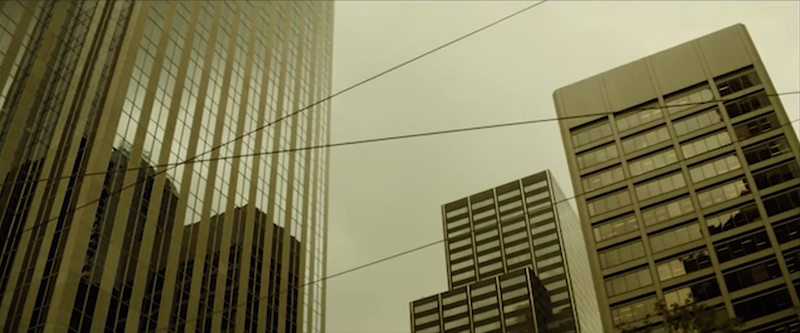
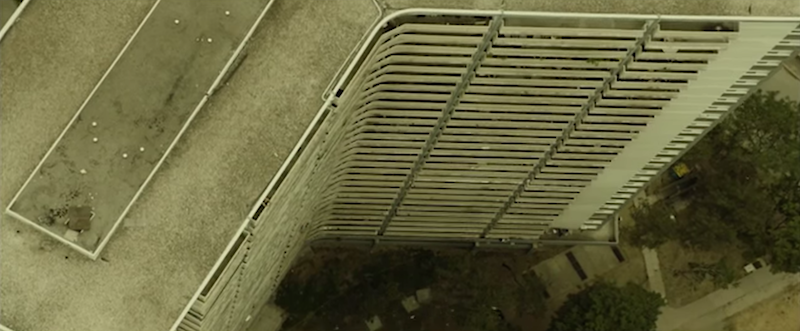
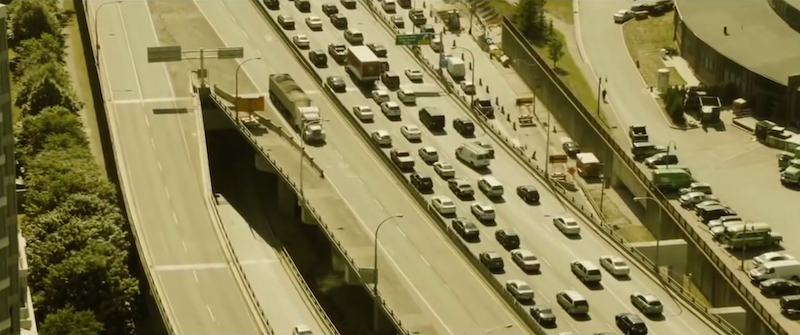
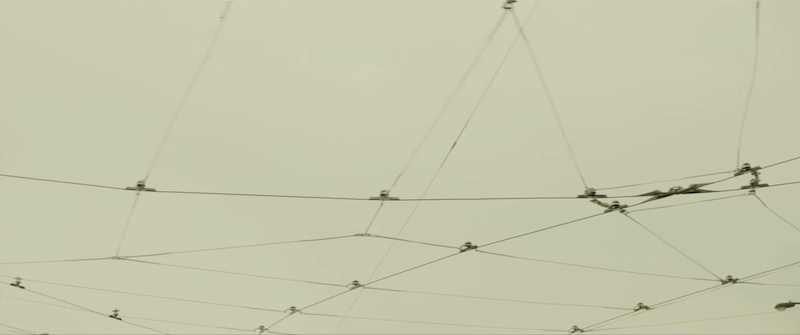
The extraordinary compositions crafted by Villeneuve and cinematographer Nicolas Bolduc are also deeply essential to the film’s oppressive aura. Enemy’s visual vocabulary contains abundant straight lines and polygons, but few curves. Characters are frequently boxed in from all sides by rigid planes of glass, metal, plastic, and concrete. Overhead, power lines criss-cross to form a looming wire canopy, amplifying that sensation that even outdoors, humankind is caged. Dismal, modernist high-rise apartment buildings tower over the landscape like long-cold industrial furnaces. From a God’s eye view, these monoliths reveal a secret geometry, the stone and steel tessellated into patterns. The film’s cityscape feels at once organic and alien, as if humankind were dwelling in the ruins of a lost insect empire.

Screen Shot 2014-04-26 at 1.43.24 PM.png
Screen Shot 2014-04-26 at 1.43.36 PM.png
Screen Shot 2014-04-26 at 7.06.04 PM.png
Screen Shot 2014-04-26 at 1.45.37 PM.png
Screen Shot 2014-04-26 at 6.52.40 PM.png
Screen Shot 2014-04-26 at 1.46.37 PM.png
Screen Shot 2014-04-26 at 1.44.21 PM.png
Screen Shot 2014-04-26 at 1.44.28 PM.png
Screen Shot 2014-04-26 at 1.44.56 PM.png
Screen Shot 2014-04-26 at 7.03.56 PM.png
Screen Shot 2014-04-26 at 5.29.09 PM.png
Screen Shot 2014-04-26 at 1.57.12 PM.png
Screen Shot 2014-04-26 at 6.51.40 PM.png
Screen Shot 2014-04-26 at 1.45.51 PM.png
Screen Shot 2014-04-26 at 1.46.24 PM.png
Screen Shot 2014-04-26 at 1.43.24 PM.png Screen Shot 2014-04-26 at 1.43.36 PM.png Screen Shot 2014-04-26 at 7.06.04 PM.png Screen Shot 2014-04-26 at 1.45.37 PM.png Screen Shot 2014-04-26 at 6.52.40 PM.png Screen Shot 2014-04-26 at 1.46.37 PM.png Screen Shot 2014-04-26 at 1.44.21 PM.png Screen Shot 2014-04-26 at 1.44.28 PM.png Screen Shot 2014-04-26 at 1.44.56 PM.png Screen Shot 2014-04-26 at 7.03.56 PM.png Screen Shot 2014-04-26 at 5.29.09 PM.png Screen Shot 2014-04-26 at 1.57.12 PM.png Screen Shot 2014-04-26 at 6.51.40 PM.png Screen Shot 2014-04-26 at 1.45.51 PM.png Screen Shot 2014-04-26 at 1.46.24 PM.png

Laurent, Gadon, and Isabella Rossellini (as Adam’s mother) each add a distinct and essential psychological facet to Enemy, but the film belongs to Gyllenhaal, who delivers a carefully calibrated and wholly compelling performance. Although technically challenging, the dual roles of Adam and Anthony tempt a facile, Jekyll and Hyde approach. Fortunately, Gyllenhaal and Gullón’s screenplay take a much more nuanced path in their depiction of the duplicates. Adam and Anthony are more akin to ragged-edged complements than perfect mirror images. 

Each man's anxieties are expressed to some degree in the other; each is a shadow in the other’s mind. Adam is both attracted to and repulsed by Anthony: his sexual aggression; his talent for deception; his status quo-affirming profession (the “circuses” that Adam decries); the stability and confinement represented by the actor’s marriage and imminent child. Likewise, Adam’s mere presence seems to incite Anthony, as though the professor’s recessive personality, stammering vacillations, and bachelor rootlessness were a personal insult. Adam and Anthony are not yin and yang in equilibrium, but annihilating matter and antimatter. As in the doppelganger legends of old, the simultaneous existence of both suggests a wound in the universe, a glitch that must be corrected. It is as though one man is a projection of the other. Chinese philosopher Zhuangzi’s riddle comes to mind (also paraphrased in Cronenberg’s The Fly): am I the First who dreamed he was the Second or the Second now dreaming he is the First?

Once the twins become aware of one another, Anthony suggests that he and Adam have a face-to-face encounter. The pair arrange to meet in a seedy motel known to Anthony, rendezvousing in a drab room where dull, brass-colored light leaks in through drawn curtains. From across this space, the two men regard each other warily. Adam cowers against the wall, shifting from one foot to the other, while Anthony approaches slowly but purposefully. They peer into each others’ eyes and hold out their hands for comparison, Adam’s trembling slightly. “Maybe we’re brothers,” Anthony offers conversationally, sounding only half-convinced. Adam, visibly frightened, shakes his head with certainty: “We’re not brothers.” When Anthony starts to become insistent and hostile, Adam flees the motel in a state of near-panic.

The meeting between the duplicates sends Adam into a psychological tailspin. Demonic arachnids invade his dreams, and his grasp on his identity becomes increasingly tenuous. Even his own mother (Rosellini) treats him as though he were someone else, confusing essential facts and trivial details of his life. Meanwhile, the meeting with his twin ignites something predatory in Anthony, whose behavior becomes increasingly intimidating and sinister. He even stalks an oblivious Mary on her commute one morning, leering at her with reptilian hunger. The actor later turns up at Adam’s apartment in an agitated state, and begins dictating what can only be described as terms of surrender. The two of them, Anthony explains, will cease all contact and never interfere in one another’s lives again, but not before he subjects Adam to a twisted, humiliating revenge for the man's supposed transgressions.

While the lines that define each man have gradually become smudged, Anthony’s scheme vandalizes those borders utterly. Visual markers that the viewer could formerly rely upon—Adam’s tweed jacket, Anthony’s wedding band—begin to vanish. The story returns to earlier locales and situations, echoing events that have already occurred. Like colliding particles governed by quantum mechanical principles, the duplicates separate and travel on distinct trajectories, but they remain entangled by invisible strands. The film eventually returns (in a fashion) to the sex club and the creeping spider, and the vague disquiet that has haunted Adam’s journey begins to rise to a keening terror.

Much of what unfolds in Enemy’s final scenes has a patina of grim destiny about it, as though the viewer were merely seeing one iteration of an algorithm that will repeat endlessly (like The Tenant’s eternal plunge into a screaming mouth). The entirety of the film becomes a prelude for its final, devastating shot, in which awareness (if not understanding) suddenly descends like a spring-loaded booby trap. That shot presents a sight that is at once shocking, baffling, and swollen with primeval terror. The truth that Adam abruptly confronts—and then accepts with a weary exhale—realigns all that has come before, and yet explains nothing. It simply affirms what the film has intimated in every frame: that the snare has already been laid, the careless step already taken, and the prey’s fate already sealed.

PostedApril 27, 2014
AuthorAndrew Wyatt
CategoriesDiary

Ghosts of Empire Prairie

SLIFF 2013: Ghosts of Empire Prairie

[3/25/14: Updated for accuracy and clarity in light of comments from actor/cinematographer Jon Jost.]

2013 // USA // Blake Eckard // November 24, 2013 // Digital Theatrical Projection (Landmark Tivoli Theatre)

[Full Disclosure: I spoke briefly with director Blake Eckard after the November 24, 2013 screening of Ghosts of Empire Prairie at the St. Louis International Film Festival. I have been an admirer of Eckard's work for some years, and have had intermittent, positive communication with him in the past.]

The rural Missouri of writer-director Blake Eckard’s features is an altogether peculiar realm. The micro-budget filmmaker has a knack for balancing the authentic and the grotesque, such that his works often feel like the spawn of a gritty docudrama and lurid fairy tale. This inimitable talent finds forceful expression in Eckard’s favored setting, the chewed-up plains surrounding his native Stanberry, Missouri. On the one hand, every detail of his films proclaim a hard-bitten intimacy with the peeling barns and sagging roadhouses of the state’s lonely northwest territory. This verisimilitude is a product not only of shoestring on-location shooting, but of a profound understanding of how the spaces and textures of Missouri’s backroads affect human relationships. On the other hand, the filmmaker portrays the region as an almost mythically forsaken land, choked with dying grass, gravel dust, and brown puddles that stink of gasoline. When one is lost in Eckard country, it is difficult to even imagine a world beyond the barbed wire fences and rutted access roads. His films seem to unfold in a kind of Purgatory Americana.

Eckard returns to these environs—part realist, part Plutonic—in his latest feature, Ghosts of Empire Prairie. To a far greater extent than his prior works, Ghosts exemplifies the director’s capable blending of the genuine and the nightmarish. While both elements are present in 2007’s Sinner Come Home and 2011’s Bubba Moon Face, those films decisively favor one or the other. Sinner is a small-town relationship melodrama with a naturalistic bent, while Bubba is an Old Testament tale of perversity and bloodshed. In comparison, Ghosts feels poised on the threshold of the tangible and the legendary. The story’s particulars are firmly rooted in its rural Heartland milieu, but its general outline evinces biblical, Western, and noir influences, as well as a dose of exploitation scuzziness.

Ghosts concerns former rodeo rider Lonnie (Ryan Harper Gray) and his dire homecoming to the go-nowhere town of Empire Prairie. There he easily slides back into the bed of local bartender and ex-flame Dawn (Arianne Martin). He also discovers that his anxious little brother Ted (Frank Mosley) is fraying into oblivion under the pressures of caring for their increasingly enfeebled, alcoholic father, Burel (veteran indie filmmaker Jon Jost). This is about all one can say of the film’s plot without undermining its vital third act revelations, but Ghosts is not as slight as such a succinct description might suggest. It is a portentous yet languid film, comprised not so much of plot points as incidents, each one putting flesh on the characters and the place that birthed them. The result is that Lonnie is perhaps Eckard’s most psychologically slippery protagonist to date: a loathsome, self-absorbed bully who is lacerated by secret agony and justifiable bitterness. To observe him descend back into the lives of his family is to become aware that something will explode eventually. Long before one suspects the nature of Ghosts’ secrets, one senses intuitively that it is building towards something gut-gnawingly awful.

This loose quality to the film’s storytelling is likely due in part to the ad hoc nature of the production. Upon learning that longtime friend and mentor Jost had a window of availability, Eckard reportedly scrambled to assemble several percolating ideas into a screenplay, and then shot the film over the course of a few days. Ghosts is, in a way, Eckard’s Mulholland Drive: a film born of exigencies, assembled from spare parts, and given a form that transcends its raw materials. Although the result feels undeniably kludgey and amorphous, it also boasts a realist intensity that exceeds that of Eckard’s more polished features. The phrase “art from adversity,” often invoked without cause in indie cinema, seems an apt descriptor of Ghosts’ successful formula. The film feels like a disturbing, half-overhead anecdote, rather than a work of fiction crafted for presentation to an audience. Undoubtedly, some of this is due to the film’s look, which is dim and grainy, like security footage broadcast from a distant planet. (The sound, meanwhile, is Ghosts’ most conspicuous formal stumble: too often the dialogue is so muffled that it is difficult to comprehend.) In addition to his role as a performer, Jost also served as Eckard's cinematographer. The collaboration's strengths are particularly evident in several shots where the camera's placement suggests a crusty-eyed hound watching events dully from the corner. These formal elements lend Ghosts a expectant, menacing vibe that is a familiar sensation in Eckard's films.

Eckard is working within a rich tradition of indie filmmakers who have provided scrupulous, nuanced depictions of significant yet neglected aspects of the American experience. These include Jeff Nichols (Shotgun Stories, Mud), Kelly Reichardt (River of Grass, Wendy and Lucy), Ramin Bahrani (Chop Shop, Goodbye Solo), and from an earlier generation, low-budget Arkansas filmmaker Charles B. Pierce (The Legend of Boggy Creek, The Town That Dreaded Sundown). Pierce, who was a kind of redneck Cassavetes, displayed great affection for his adopted Southern home, although it did not dissuade him showing the meanest, ugliest aspects of Dixie life. Eckard has a similar interest in the dark side of rural America—not a cartoonish world of racist sheriffs and menacing hillbillies, but country life as it actually experienced.

In Ghosts, the noxiousness that wafts from Lonnie and his family is not unique to their rotten clan. It permeates the blood and minds of Eckard’s hellish Missouri, turning everything to bile. It is this aspect of the director’s works that lingers the longest: his precise evocation of a nasty stripe of backroads nihilism. The men (and a few women) who populate Eckard's films are frequently anti-social and stunted souls, worn down by hardship and bored dissatisfaction. They don’t have any interests beyond complaining, drinking, and fucking, and the faces they present to the world seem limited to sneering contempt, seething self-pity, and blank, quaking anger. They are people who drink Busch Light in pressboard bars because there are no alternatives, and would snort derisively at the notion of “white privilege”. It’s a strain of rudderless blue collar hostility that is immediately familiar to any Midwesterner who has lived or tarried beyond the suburbs. Eckard’s presentation of this culture is not caricature—as it is in so many films, both Hollywood and indie—but raw, feverish portraiture of the Real America that is alternately sanctified and denigrated in the popular imagination.

PostedJanuary 26, 2014
AuthorAndrew Wyatt
CategoriesDiary, SLIFF 2013
2 CommentsPost a comment

Sleeping With the Fishes

SLIFF 2013: Sleeping With the Fishes

2013 // USA // Nicole Gomez Fisher // November 23, 2013 // Digital Theatrical Projection (Landmark Tivoli Theater)

[Full Disclosure: Sleeping With the Fishes was one of five debut feature films in the juried New Filmmaker’s Forum competition at the 2013 St. Louis International Film Festival. I served on the NFF jury, and spoke with director Nicole Gomez Fisher briefly at the SLIFF Closing Night Party. This review is intentionally biased to provide an affirmative, constructive evaluation of the film.]

An unusual species of humor bubbles through the screenplay of writer-director Nicole Gomez Fisher’s Sleeping With the Fishes. That humor relies to a great extent on the charm of lovable, over-the-top characters doing nothing more than showcasing their personalities. Fishes is not a film that sizzles with outrageous jokes, pithy one-liners, or quotable digressions. However, it is funny, in the way that an absurd anecdote provokes a helpless smile. The script contains traces of Woody Allen’s mopey, self-effacing neuroticism as well as Kathy Griffin’s catty, hyperbolic storytelling. While its eccentric sensibility misses as often as it connects, Fishes is a remarkably assured comedy for a feature film debut. The distinctive pleasures of the film lie in observing the members of the titular Fish family alternately snipe at and comfort one another, and in the way that Fisher coaxes the viewer to root for her hapless heroine.

That would be Alexis Fish (Gina Rodriguez), a high-strung twentysomething who fled her Brooklyn upbringing to marry what she thought was the man of her dreams. Over the course of the past year, however, Alexis’ life has come crashing down around her. Her husband died in an accident, which not only exposed his history of secret infidelity but also saddled her with a small mountain of debt. Mired in depression and fumbling through a series of low-paying, menial jobs, Alexis desperately needs a fresh start. Fortunately, one presents itself when her endearingly geeky sister Kayla (Anna Ortiz) urges her to return to New York. Ostensibly, this homecoming is for a relative’s funeral, but in actuality the sisters are plotting to kickstart Alexis’ dormant career as a party planner. Unfortunately, this means that Alexis must confront her hyper-critical mother, Estella (Priscilla Lopez), who seizes every opportunity to comment on her daughter’s appearance and catalog her alleged blunders.

Needless to say, such needling is precisely what Alexis does not need as she struggles to claw her way out from under her misfortunes. The angst of the mother-daughter relationship is the foundation on which the rest of Fishes’ drama is erected. The film’s conflicts are relatively low-stakes, but for Alexis they seem enormous. Her future financial security depends on her planning and executing an extravagant bat mitzvah for an awkward tween (Misha Seo). Her shattered confidence perks up at the sight of sensitive heartthrob Dominic (Steven Strait), but the nascent relationship is stalled by misunderstandings. As Alexis attempts to move past her humiliating and dispiriting recent past, every step forward seems to be followed by two steps backwards. Sister Kayla offers enthusiastic encouragement, but Alexis’ mother is always there, ready to offer her opinion on exactly how her daughter has erred.

As with many indie comedies, the film's most serious weaknesses lie in pacing and structure. Too often, scenes feel excessively and haphazardly episodic, more like standalone sketches from improv night than slices of a cohesive narrative. Fortunately, Fishes generally maintains a cartoonish, somewhat breathless tone that keeps things moving through sequences of deadpan snark and general sitcom zaniness. Fisher is adept in her treatment of Alexis’ mixed Latina-Jewish heritage, which is integral to the film’s personality but never threatens to devours the story. Alexis’ ethnic identity finds expression not only in her anxious, sharp-tongued persona, but also in the film’s biting but warm-hearted depiction of her parents. Estella and Leonard (Tibor Feldman) simultaneously embody and subtly tweak stereotypes regarding Latin mothers and Jewish fathers, and it is in their private moments with Alexis that the film finds a touch of honest-to-goodness pathos.

The challenge (and occasional necessity) of starting over in life is the prevailing theme of Fishes, and while the film has nothing particularly novel to say on the subject, it is nonetheless an enjoyable little bauble. Rodriguez is astonishingly precise in her portrayal of Alexis, conveying just enough insecurity and goggle-eyed panic that one can believe a woman as smart, sexy, and witty as she could still be an absolute train wreck under the right circumstances. That the viewer is pulling for Alexis by the end is not attributable solely (or even mostly) to her pitiable situation. Rather, it rests on the character's instinctive goodness, quick thinking, and sheer pluck in the face of adversities that would have defeated a lesser woman. Despite what her mother may insist, Alexis is worthy of a little love and success just as she is.


PostedJanuary 18, 2014
AuthorAndrew Wyatt
CategoriesDiary, SLIFF 2013

How We Got Away With It

SLIFF 2013: How We Got Away With It

2014 // USA // Jon Lindstrom // November 23, 2013 // Digital Theatrical Projection (Landmark Tivoli Theater)

[Full Disclosure: How We Got Away With It was one of five debut feature films in the juried New Filmmaker’s Forum competition at the 2013 St. Louis International Film Festival. I served on the NFF jury, and spoke with director Jon Lindstrom briefly at the SLIFF Closing Night Party. This review is intentionally biased to provide an affirmative, constructive evaluation of the film.]

Director Jon Lindstrom’s ambitious debut feature, How We Got Away With It, functions as a mystery on many levels. As it says right there in the title, the film concerns the process by which a group of unlikely individuals successfully commit and cover up a brutal crime. Yet the film is as concerned with the What and Why as it is with the How. For a hefty portion of the How's running time, the exact misdeed that is perpetrated remains murky, until it is abruptly revealed in a vicious, startling flashback. Most crucially, the motive for the crime is only explained in the final scenes, creating a nagging itch that scurries beneath the surface of the film, always just out of reach.

This somewhat elliptical approach to what is otherwise a straightforward tale of bloodshed and lies is both How’s most distinctive narrative feature and its most confounding flaw. The screenplay, co-written by Lindstrom and actors McCaleb Burnett and Jeff Barry, begins with a solid, even intriguing premise. A circle of thirtysomething friends are gathering for their annual hang-out at the sprawling seaside home of Henry (Burnett), an affable restaurateur. Before the festivities kick off, however, Henry arrives home to find a dead woman swinging from a rope in his dining room.

The questions begin accumulating immediately: Who is the deceased? Why did she end her life? Why does Henry not call the police, but instead hastily cut down and conceal the body before his friends arrive? That How feels no particular need to rush answers for these or any other queries is indicative of the film’s approach to story development. It favors a light, quasi-naturalistic touch that can occasionally be frustrating in its obfuscations. As the guests begin to appear, the lay of the land only get more convoluted. It takes some time to sort out who everyone is, what their relationships to one another are, and whether any particular individual is involved in Henry’s plans. As it turns out, the host has a dark scheme in mind for the weekend, a plot whose urgency only seems to have been heightened by the suicide cover-up.

Henry is mellow and gregarious with his friends, but privately wary and cold-blooded. In short order, he reveals his designs to his vaguely loutish but devoted friend Will (Barry) and unintentionally pulls in the group’s token burnout, Ronnie (Jacob Knoll). Both men reluctantly agree to assist Henry with his plan, which entails a sinister fate for a man named Walter (Richard Bekins). An older, middle-aged drunk employed at Henry’s restaurant, Walter is plainly loathed by the man and his friends, but as with many elements of How’s story, the reasons are initially obscured.

Meanwhile, numerous other story threads are woven into the film’s fabric, not all of them especially enriching: relationship troubles between Will and his girlfriend Leigh (Mikal Evans); Elizabeth’s (Brianne Moncrief) awkwardness as the outsider in the group; and Dallas’ (Luke Robertson) mounting agitation at the absence of Henry’s sister, Sarah (Samantha Soule). Eventually, a dogged police detective (Lindstrom) begins skulking about and engaging in some highly questionable search and seizure practices.

How's screenplay desperately could have used further revisions, at it is swollen with needless character details, repetitive scenes, and go-nowhere subplots. The script doesn’t feel so much unpolished as half-finished and undisciplined. The cast could have been pruned of one or two characters with no discernible effect on the story, beyond tightening it up considerably. Certainly, Henry’s girlfriend Anne (Cassandra Freeman) serves no particular purpose in the narrative, and Leigh mostly drops out of sight after a quarrel with Will. At times, distracting implausibilities bring the film screeching to a halt—as in the aforementioned dodgy policework—which is unfortunate given that How’s dominant sensibility is that of a tightening vice. The film’s performances are serviceable but mostly unremarkable. Burnett must carry most of the scenes, and he rises to the occasion capably. While his Everyman good looks and laid-back demeanor initially seem a poor fit for a criminal schemer, Burnett shapes Henry into a credible character: perceptive, quick-witted, smooth at deception, and wracked with secret anguish.

Despite the script’s serious issues, there is something unsettling about How. It’s in the strange menace that Lindstrom evokes from the alluring summer beaches of the film’s Rochester, New York setting and from Henry’s breezy, slightly gaudy home. It’s in the way that the film’s indefinite sympathies and narrative obliqueness recall Hitchcock and Haneke, respectively, without making a self-important point about doing so. It’s the sudden manner in which the film’s deliberateness and understatement give way to sickening brutality in the third act, such that it seems like a chilling plunge into gangster or horror cinema.  At the SLIFF screening, Lindstrom cited The Virgin Spring as an influence, but it is Wes Craven’s post-Manson family remix of that film, The Last House on the Left, that seems more closely entwined with How's darkling aspect. Such points of engagement render How We Got Away With It a far more intriguing work than its distressingly rough-edged story would otherwise suggest.

PostedJanuary 17, 2014
AuthorAndrew Wyatt
CategoriesDiary, SLIFF 2013

This Is Where We Live

SLIFF 2013: This Is Where We Live

2013 // USA // Josh Barrett and Marc Menchaca // November 23, 2013 // Digital Theatrical Projection (Landmark Tivoli Theatre)

[Full Disclosure: This Is Where We Live was one of five debut feature films in the juried New Filmmaker’s Forum competition at the 2013 St. Louis International Film Festival. I served on the NFF jury, which ultimately awarded the NFF Emerging Director Award to This Is Where We Live directors Josh Barrett and Marc Menchaca on November 24, 2013. This review is intentionally biased to provide an affirmative, constructive evaluation of the film.]

The nickel summary of Josh Barrett and Marc Menchaca’s debut feature, This Is Where We Live, creates a very specific set of expectations. In the hill country of central Texas, thirtysomething handyman Noah (Menchaca) is abruptly pulled into the lives of the troubled Sutton family to work as a caretaker for young adult son August (Tobias Segal), whose cerebral palsy has rendered him nearly immobile and non-verbal. As one might expect, bonds are formed, friction arises, and wisdom is attained. It’s the sort of story that naturally lends itself to cloying, faux-uplifting cinema, palatable to middlebrow art house audiences and completely unmemorable.

What makes This Is Where We Live so distinctive is its tart refusal to fulfill these expectations. The film consistently avoids cliche in favor of a nuanced, authentic portrait of a hard-bitten, blue collar Middle America.  Much of the credit is due to Menchaca’s script, with a story assist provided by Barrett. Where some screenwriters might be tempted to subvert the well-worn formulae of indie drama by exploding it, the writers of This Is Where We Live take a gentler approach. The film refuses to confine its characters within tired archetypes, and favors a naturalistic story progression over contrived plot developments.

A case in point is Noah himself, who in a lesser feature would be a colossal jerk who discovers his capacity for selfless compassion by tending to August’s needs. In fact, Noah’s good-natured character is apparent from the outset, as evidenced by his joking manner with August and his unflinching acceptance of matriarch Diane’s (C.K. McFarlane) job offer. Yet Noah is no angel: frequently frustrated by August's actions and his own inability to communicate effectively with the man, their relationship is a fitful and uneasy one. Although the handyman’s time with the Suttons throws new light on his own troubled history, Noah’s personal journey is not the most conspicuous aspect of the film’s story. Rather, This Is Where We Live is primarily a tale of clashing personalities and assumptions, where the dynamics between the abled and disabled—and between family and outsider—play a crucial role.

Another prominent example of the film’s heterodox qualities is long-suffering Diane, who would normally be the most sympathetic character in the story. She’s a pummeled and exhausted woman, drowning under the demands of her afflicted son, a husband (Ron Hayden) suffering from early dementia, and a listless, combative daughter (Frankie Shaw). To these burdens are added Diane's own secret help problems and the sadly typical economic hardships of small town life. Yet while Barrett and Menchaca present Diane as pitiable, she is a hardly a self-sacrificing saint. Her dyspeptic, stodgy, and over-protective tendencies set her into conflict with her family and with Noah, whose almost naive eagerness to make August happy leads him to stray from his caregiver duties into the questionable role of best pal. Diane watches over her son jealously, and is loathe to allow anyone else decide what is best for her family.

This sort of off-center approach to what could have been a irksome, saccharine tale is essential to the appeal of This Is Where We Live. Perhaps it’s a bit of a backhanded compliment to assert that a work’s finest achievement rests on what it doesn’t do, but there is still plenty to admire in the film’s acting and aesthetics. Segal, who does not have cerebral palsy, dives into the role of August with ferocity and delicacy in equal measure, without making the film all about his necessarily splashy performance. (August’s condition is not the central pillar of the film, but more akin to the star around which the story's events orbit. The distinction is vital.) The rest of the cast is also in fine form, with Hayden in particular making a strong impression. Cinematographer Ryan Booth provides the Lone Star landscape with a glint of loveliness to offset all the dust and peeling paint, recalling a lo-fi version of Bradford Young’s recent work on another Texas tale, Ain’t Them Bodies Saints.

The missteps in This Is Where We Live are mostly at the high-altitude level. It’s hard to find fault with any scenes when they are considered individually, but as a whole the assembled film has a certain shagginess to it, and an unfortunate habit of repeating itself. Although it is already lean at 92 minutes, a bit of bloody-mindedness in the editing room could have made the film positively hum. At times, Barrett and Menchaca treat some aspects of the story with such a light touch that it seems less like dog-eared realism and more like gratuitous elision. In particular, Noah’s past remains a foggy cluster of grief and resentments, which wouldn’t be a concern if the film didn’t regard that past as an essential aspect of his character. These complaints aside, This Is Where We Live is a remarkably strong first-time feature. A consistently surprising and carefully considered work, it reveals that complex human drama is still out there, waiting to be discovered in the substrate of rural America. It feels true, which is a rarified thing in an increasingly flattened and unadventurous topography of indie filmmaking.

PostedJanuary 6, 2014
AuthorAndrew Wyatt
CategoriesDiary, SLIFF 2013
Newer / Older
RT_CRITIC_TM_BADGE.jpg
The Take-Up Podcast

Twin Peaks: The Return

2007 - 2016: A Personal Cinematic Canon

download.png

Recent Posts

Blog
New Reviews at The Take-Up
about 8 years ago
Miles to Go Before I Sleep
about 8 years ago
Delete Your Account: 'Friend Request'
about 8 years ago
Feminine Mystique: 'mother!'
about 8 years ago
Unmuffled Screams and Broken Hearts - 'Twin Peaks: The Return,' Parts 17 and 18
about 8 years ago
Send in the Clown: 'It'
about 8 years ago
Unmuffled Screams and Broken Hearts - Twin Peaks: The Return, Part 16
about 8 years ago
Fetal Infraction: Prevenge
about 8 years ago
You Don’t Know Why, But You’re Dying to Try: The Lure
about 8 years ago
Unmuffled Screams and Broken Hearts - Twin Peaks: The Return, Part 15
about 8 years ago

© 2007 – 2026 Andrew Wyatt