Blog
About
Indices
Films by Title Gateway Cinephile Posts by Date The Take-Up and Other Posts by Date Horror Cinema David Lynch's Shorts John Ford's Silents H. P. Lovecraft Adaptations Twin Peaks: The Return Westworld Freeze Frame Archive
What I Read

Gateway Cinephile

Appreciation and Criticism of Cinema Through Heartland Eyes
Blog
About
Indices
Films by Title Gateway Cinephile Posts by Date The Take-Up and Other Posts by Date Horror Cinema David Lynch's Shorts John Ford's Silents H. P. Lovecraft Adaptations Twin Peaks: The Return Westworld Freeze Frame Archive
What I Read
LateBloomersPoster.jpg

SLIFF 2008: Late Bloomers

2006 // Switzerland // Bettina Oberli // November 14, 2008 // Theatrical Print (Landmark Plaza Frontenac Cinema)

I'll allow that Late Bloomers manages to be "heartwarming," but only in the most calculated and undemanding way. Bettina Oberli's story of elderly women who open a lingerie shop in a tiny, conservative Swiss village wears its life-affirming, faux-rebellious intentions with pride. There's not much to object to here from a storytelling perspective: Oberli introduces four women with a panoply of personal problems, adds some obligatory crises, and by the time the credits roll all is neatly (if not happily) resolved. The villains, primarily a political leader (Manfred Liechti) and the village parson (Hanspeter Müller)—both sons of the entrepreneurial women—are so aggressively loathsome that there's no wiggle room in the story. Doubt creeps in for Oberli's silver dames when their enterprise gets rocky, but Oberli signals with simplistic strokes that unexpected thematic shifts aren't in order (just cheap tragedy). What we're left with is "Be True to Yourself" pablum, served up with rich helpings of schadenfreude and a knowing condemnation of rural Swiss stuffiness. The film's saving grace is Stephanie Glaser as ringleader Martha, a widowed hausfrau portrayed with a fine blend of tentativeness, moist romanticism, and comic spunk.

PostedNovember 15, 2008
AuthorAndrew Wyatt
CategoriesSLIFF 2008
HumboldtCountyPoster.jpg

SLIFF 2008: Humboldt County

2008 // USA // Darren Grodsky and Danny Jacobs // November 13, 2008 // Theatrical Print (Landmark Tivoli Theater)

The tale of a medical student who bumbles into a marijuana farming community, Humboldt County has all the ingredients for a sincere puff of humane drama, despite its at times condescending tone. The fairly ho-hum narrative arc never misses a beat, yet it's still a pleasure to watch it unfold. Credit Grodsky and Jacobs' nimble script, fine editing from Ed Marx, and Ernest Holzman's adaptive, sneakily effective camera work. Humboldt boasts some amazingly potent long shots, whose strength lies in the centrality of their human subjects and their lack of showiness. Brad Dourif and Frances Conroy deliver astonishing, husky performances far better than any indie coming-of-age drama should warrant. Grodsky and Jacobs are plainly striving for a tale of personal transformation, and on that score Humboldt never quite ripens. The problem lies in the mismatch between the film's aims and Jeremy Strong as protagonist Peter. Strong reads as a sort of older, broader, more wilted Michael Cera, and in another film his starched, stammering schlemiel routine might have been bitterly funny. Yet Peter's sheer anxious discomfort in his own skin is too pronounced in a role that needs a touch of melancholy despair and callous apathy.

PostedNovember 14, 2008
AuthorAndrew Wyatt
CategoriesSLIFF 2008
SynecdochePoster.jpg

Synecdoche, New York

Turtles All the Way Down

2008 // USA // Charlie Kaufman // November 9, 2008 // Theatrical Print

A - Screenwriter Charlie Kaufman's directorial debut, the maddening, devastating Synecdoche, New York, wanders in the twilight world usually reserved for the bleakest of existential novels. It reflects a disquieting comfort with the folding of reality and mind within the dark whorls of creative frenzy, as well as a gluttony for morbidity that borders on the obscene. This is a film that has no use for reason. However, its nightmarish illogic is so powerfully rendered and so robustly intuitive that it demands our attention, devours it even. With Synecdoche, Kaufman has created his densest and most sublime film to date, striking a dizzying balance between conventional romantic tragedy and unabashedly grave philosophical conundrums. This film has perplexed me, but I cannot stop marveling at it. Much like Tarsem Singh's phantasmagorical hymn to storytelling, The Fall, Synecdoche hums with the electricity of a novel form of cinematic life, a grand work teetering on folly. It must be seen to be believed.

How does one begin to describe a dream? Philip Seymour Hoffman, in what is most assuredly the performance of his career, portrays Caden Cotard, a sad-sack theater director in upstate New York. Caden is deeply unhappy, perpetually on the verge of a complete physical and emotional breakdown. He is obsessed with his own mortality, and seems to offer nothing positive to his wife Adele (Catherine Keener) or his young daughter Olive (Sadie Goldstein). In the film's early scenes, there are hints that not all is as it seems in Caden's ugly existence. He glimpses himself in the cartoons and prescription drug advertisements on television, and time proceeds oddly. Adele, an artist whose canvases are no bigger than postage stamps, declares that she is moving to Germany, and taking their daughter with her. Caden is emotionally ruined, but he's also concerned about his teeth, his eyes, his urine, and the pustules on his face and legs. His wide-eyed, somewhat demented therapist (Hope Davis) is occupied solely with hawking her self-help books. The gorgeous lead actress in Caden's production of Death of a Salesman (Michelle Williams) seems to have eyes for him, but his fixation is the box-office clerk, a radiant redhead named Hazel (Samantha Morton). Women seem to fill every corner of Caden's life, and every female encounter seems to promise another path to misery. Hazel, by the way, lives in a house that is on fire, but never seems to burn down. (In a superb delayed reaction, she tours the house with a realtor, chatting about her finances and the property's qualities, before finally admitting, "I'm sort of concerned about the fire.")

When a MacArthur genius grant improbably arrives in Caden's lap, he envisions an epic work of original theater, something "true." (Are unknown Schenectady theater directors typically so honored?) He rents an enormous warehouse--a hanger, really--in New York City and begins to assemble his magnum opus. His cast includes dozens of actors at first, then hundreds, then thousands. Within the warehouse a colossal set takes shape, an artificial city. Months of development turn into years. Caden's vast production begins to encompass events from his own life, eventually boasting recreations of scenes that we have already witnessed. To play himself, Caden casts Sammy (Tom Noonan), an actor who has been stalking him for two decades. Sammy is an eager study who follows Caden everywhere and dutifully notes the color of his stool. (This isn't as outlandish as it sounds, as Caden himself is fixated on his excreta.) Meanwhile, Adele and Olive have disappeared into the avant-garde German art scene, where Caden's attempts to communicate with his daughter--now a tattooed muse under the wing of a female lover (Jennifer Jason Leigh)--are cruelly rebuffed.

I could go on forever recounting the swollen details of Synecdoche's essentially baffling story, but to do so would not convey the addictive sense of the unmoored that Kaufman sculpts. He conjures an aura of demented connection and significance that can only be described as dream-like, treading the paths of Cronenberg at his most determinedly surreal (e.g. Naked Lunch) or Lynch on any given night. Synecdoche recalls Kaufman's own Being John Malkovich in its taste for hallucinatory desperation and outrageous metaphor. The latter doesn't always succeed as well a Kaufman imagines. Late in the film, Hoffman speaks to his grown daughter by means of an electronic translator, as she only understands German. Get it? They don't speak the same language anymore. This sort of daft literalism preoccupies Kaufman to the point of distraction, but it never truly irritates, perhaps because his performers are so absorbed into the film's fabric of uncanny gloom. There is no winking acknowledgment of Synecdoche's silliness or strangeness. This is part of the film's curious magic: Its ability to convey absolute sincerity while giggling madly.

Synecdoche's fascination with identity and Möbius narrative echoes not only Lynch's late masterworks, but also Polanski's The Tenant. The whole world seems to conspire in the utter disintegration of Caden Cotard. Kaufman suggests that Caden creates art not for the benefit of others but in order to unlock the mystery of his own life. However, even the play eventually turns on him. Sammy casts another "Sammy" in a play within the play, as well as other "Hazels," and everyone becomes confused about their role in the production (read: universe). Family members and strangers call Caden's sexuality and gender into question, and when he casts an actress (Dianne Wiest) in a pivotal role, the two seem to switch places. Time and place roil and ooze together, with Olive's childhood diary seeming to prophecy the future and New York blending into Germany blending into Fake New York. Eventually, Caden notices a map of his set showing a series of warehouses, nested like matryoshka dolls: Warehouse 1 contains Warehouse 2 contains Warehouse 3 contains... How far down does it go? Does this fractal-reality provide illumination somewhere within its depths, or is it obfuscating Caden's understanding of his nature? Is the play itself a hallucination or deathbed fugue, an attempt by a lucid dreamer to organize his desires and fears? Kaufman doesn't provide a definitive answer. However, in Synecdoche's final scenes he suggests that our path might be scripted and end in ashes, but the final enlightenment is no less potent and no less sweet.

PostedNovember 13, 2008
AuthorAndrew Wyatt
CategoriesReviews
CommentPost a comment
IveLovedYouPoster.jpg

I've Loved You So Long

2008 // France // Philippe Claudel // November 11, 2008 // Theatrical Print

B - Kristin Scott Thomas is the skin, flesh, and bone of I've Loved You So Long. Director Philippe Claudel, in his first feature film, is keenly aware of how central his lead actress is to the potency of this studious, intimate drama of forgiveness, forgetting, and starting over. Thomas' presence hovers over every moment of the film. Claudel spends long minutes waiting with a cinematic exhale caught in his throat, savoring the way Thomas glances, sighs, smokes, and stands. The entire story—of a woman's entry into her younger sister's family life following a prison sentence—seems to lie in the veteran actress' eyes, so sharp, luminous, and haloed with middle-aged wear and beauty. Never mind the hackneyed bits and dramatic missteps. (Wine-lubricated confession at a French dinner party? Check! Tear-smudged, slightly underwhelming revelation? Check!) Also marvelous are Laurent Grévill and Frédéric Pierrot, who charm Thomas' Juliette in scenes scripted with distinctly Gallic confidence and deep currents of hope. I've Loved You So Long just might be the film of Thomas' career. It succeeds despite an unsatisfying final act and too much narrative thumb-twiddling. It succeeds because Thomas is just that damn good, and Claudel bottles every spark she generates.

PostedNovember 13, 2008
AuthorAndrew Wyatt
CategoriesQuick Reviews
CommentPost a comment
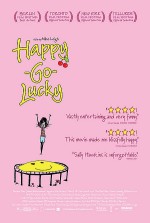
HappyGoLuckyPoster.jpg

Happy-Go-Lucky

​Manic Pixie Dream-Girl

2008 // UK // Mike Leigh // November 11, 2008 // Theatrical Print

B - Mike Leigh's Happy-Go-Lucky is a slippery little film, a work that appears—at first glance—to rest on the spritely shoulders of one Poppy Cross, as portrayed with rabbit-punch wit and astonishing texture by Sally Hawkins. Indeed, Hawkins is undeniably the blazing celestial orb of positivity of this slice-of-life dramatic comedy. Making Sally Hawkins charming is an amateur's trick, demanding nothing more than attiring her in "crazy" outfits and letting her goggle and guffaw through a flurry of sitcom scenarios. (Driving lessons! Visiting her sister! Flamenco class!) However, Leigh's magic lies in the way he shifts our attention from Poppy to the world around her, never mind how enchanting a heroine she might be. Quite improbably—and in spite of her saccharine eccentricities—Poppy emerges as a rounded character, one who permits us a bit of projection for our own everyday tribulations. Shock of shocks, before long we realize that Happy-Go-Lucky is not merely touting the power of optimism, but calling our attention to the ley-lines of misery that flow between annoyances, social ugliness, and outright tragedies.

Poppy is a middle-school teacher in London, a thirtysomething who takes pleasure in her job and her small circle of acerbic chums. Inventorying Poppy's spirited, not-quite-oddball lifestyle reveals a bit about her: weekends spent brainstorming projects for her class, drinking and dressing on nightclub crawls as if it's 1985, and bouncing on a trampoline to stay in shape. Thanks to Hawkins' overwhelming, remarkably delicate portrayal, what seems at first like an overdose of affected quirk evolves into a moving role that invites both adoration and reflection. Director Leigh evinces a sharp awareness of the sad, sexist cinematic trope of women like Poppy "rescuing" starched shirts far beneath their worth, if only in the sense that Happy-Go-Lucky is distinctly not such a film. It is Poppy's tale, and therefore about how she responds to a world of cruddy luck and hostile asses. She eventually encounters a man who she could be content with, but he—like all the other characters of Happy-Go-Lucky—dwells a little outside the camera's focal point. We can see what makes these people alluring or distressing in Poppy's eyes, but they also appear to have lives off-screen. It's refreshing to watch a film-maker build a convincing comedic landscape around a protagonist with such assurance and social perceptiveness.

There isn't much of a plot to Happy-Go-Lucky, strictly speaking. We follow Poppy for several weeks, and stuff happens to her, with some events entangling in a manner that exhibits Leigh's sensitivity to life's rhythms and uncanny juxtapositions. The film thrusts no climactic crises on Poppy, at least in the conventional screenwriting sense, nor any oh-so-convenient triggers for a seismic shift in her outlook. She confronts problems and has a couple of scary moments, but these eventually reveal themselves to be frightening for what they suggest about the world, not for any lasting harm they might do to our plucky protagonist. Poppy essentially remains the same from opening credits to final shot. The narrative motion of Happy-Go-Lucky occurs in the world outside her door, revealing a landscape far more unpleasant than she (or us) could have envisioned, a world choking on its own anger. Perhaps this is why Leigh conjures for us a Pollyanna of such determined sparkle. Only with her as our bouncing beacon could we ever break through the thick haze of stupidity, heartbreak, and bigotry that blankets modern life. Much of the cunning appeal of Hawkins' performance is that she never attracts our envy or resentment. Her performance is not in any sense one-note or grating, although it seems for all the world as though it should be. Hawkins and Leigh offer a Poppy that is at times terrified, confused, or melancholy, almost always in the right dose to establish her authenticity.

In short, this is a film that is all about a performance, and what the director does with that performance. There's nothing particularly head-turning in Happy-Go-Lucky's visual language, and the film admittedly suffers from some uneven pacing and editing that unnecessarily clouds the passage of time. These problems don't seem particularly bothersome, however, given how Hawkins so deftly orients the viewer from scene to scene with her portrayal. Leigh, notorious for evolving his films through improvisation, captures golden moments that play out with both naturalism and precision. Hawkins and her fellow performers—particularly Aleixs Zegerman as roommate Zoe and Samuel Roukin as school counselor Tim—find a witty, endearing rhythm. These social wonderments are Happy-Go-Lucky's most conspicuous ornaments, but the dramatic potency of the film lies in Leigh's determination to make a film featuring a happy protagonist that is primarily about unhappiness. Rather than yanking Poppy to and fro with a locomotive story, Leigh relies on her as a resilient observer, one whom we don't mind dawdling with. With us peering over her shoulder, Poppy takes a hard look at her own understanding of the origins of fear, anger, and despair. She comes to no grand revelations, but she discovers a world more rotten than she expected. How tragic! How much more essential, then, that Poppy fill her life with laughter instead of bitterness. Now that I'm at the end, I can see why the appeal of Happy-Go-Lucky is so simple: It states the obvious with glorious warmth.

PostedNovember 13, 2008
AuthorAndrew Wyatt
CategoriesReviews
CommentPost a comment
ChangelingPoster.jpg

Changeling

Motherhood, Interrupted

2008 // USA // Clint Eastwood // November 5, 2008 // Theatrical Print

C - The most rote film that Clint Eastwood has directed in at least a decade, Changeling is a grim, sprawling, fairly unremarkable period drama. It's not a bad film by any means: gloriously detailed, solidly acted, and shot with a cool, painterly eye. It's also maddeningly predictable to the point of tedium, and at least forty-five minutes too long given the absence of any narrative shakeups. Is is really possible that the man behind the Olympian deconstruction of Unforgiven and the bleak soul-searching of Million Dollar Baby could create a film bloated on such uninspired to-and-fro? The term "well-made" as backhanded compliment never seemed more appropriate: Changeling is a film that cues its required quota of approving nods and gasps of outrage, an archetypal Serious Adult Drama. Again, not a bad film by any means, but I can't shake the impression that it's a step backwards for the veteran American un-auteur.

In 1928 Los Angeles, telephone technician and single mom Christine Collins (Angelia Jolie) lives with her young son, Walter (Gattlin Griffith) in a modest bungalow. After working late one day, Christine returns to an empty house. Walter has vanished, and Christine is shocked to discover that the police won't even begin looking for her son until 24 hours have passed. (If only she had lived in the era of Law & Order, she would have known this.) Christine's interactions with the notoriously corrupt Los Angeles police department only go downhill from there, particularly with respect to the imperious, condescending Captain Jones (Jeffrey Donovan). Eventually, miracle of miracles, the LAPD presents Christine with Walter, alive and well. Except: "That's not my son!," Christine exclaims for the first of several hundred times. In the glare of the press' flashbulbs, Captain Jones grimaces and quietly pleads with Christine to take the strange boy home, "on a trial basis."

Case closed, the police declare cheerfully, for they need the public relations coup of a reunited mother and son. Christine, however, will not be dissuaded. Her insistence that "Walter" is not her Walter eventually leads to a personal crusade against the LAPD, wherein she joins forces with a local activist minister and radio host (John Malkovich). When Christine goes public with her accusations, Jones waves his hand and she is hauled off—er, "escorted"—to a mental hospital, where casual misogyny gives way to clinical sadism. Fortunately, Christine's salvation and vindication are set in motion when the no-nonsense Detective Yberra (Michael Kelly) heads off into the desert for a routine deportation. His search leads him into the ugly heart of one of the most notorious crimes of the early twentieth century, and therein may lie the answer to Christine's ultimate, aching question: Where is my son?

Changeling provides a rare, harrowing glimpse of a fading (but not vanished) nightmare-America, where the police behave like cruel potentates and women are little more than bothersome children to be dismissed and punished. The film's moral and social commentary, while admirable, is scraped too thinly over too vast a landscape. Changeling aspires to tackle sexism, psychiatry, police corruption, the treatment of children, criminal guilt, and the death penalty. However, Eastwood and screenwriter J. Michael Straczynski are just nibbling at a Serious Issues buffet. Earnest and decidedly unambitious, Changeling is so aggressively Sociology 101 in its tone that one can envision the Discussion Questions: "How does the LAPD's treatment of Christine reflect society's perception of women in 1928?" The film's shallow approach to such matters undercuts their novelty and necessity.

Happily, Jolie is a comfortable fit for the material and the era. Smokey-eyed and crimson-lipped beneath her flapper hats, she captures the doggedness and vulnerability that a credible mother-in-peril role demands. Still, it's essentially a serviceable portrayal, as are most of Changeling's performances (Malkovich in particular seems to be phoning it in). Only Michael Kelly manages to engage, especially in the film's pivotal and unquestionably finest scene, where Yberra's interrogation of a child suspect is swept along on a tide of shock and swelling dread. While Changeling's drama might be merely competent, its period trappings are wondrous, a landscape to truly savor. Rich in 1920s and 30s detail, it's the sort of feature that production designers live and die for. Fiercely meticulous without ever exhibiting an indulgent streak, Deadwood alum James Murakami's Los Angeles commands our attention in every shot.

I feel as though I'm underselling Changeling's strengths, so let me clear: It's a fine film, an effective slice of drama that marches along from Points A to B to C with nary a hitch. Provided one is comfortable with the plodding pace and engaged in the scenery passing by, there's not much to actively dislike here. Eastwood offers us exactly the sort of straight-arrow storytelling and bland righteousness that's endemic to late autumn prestige pictures. So why do I feel a little bit cheated?

PostedNovember 8, 2008
AuthorAndrew Wyatt
CategoriesReviews
1 CommentPost a comment
Newer / Older
RT_CRITIC_TM_BADGE.jpg
The Take-Up Podcast

Twin Peaks: The Return

2007 - 2016: A Personal Cinematic Canon

download.png

Recent Posts

Blog
New Reviews at The Take-Up
about 8 years ago
Miles to Go Before I Sleep
about 8 years ago
Delete Your Account: 'Friend Request'
about 8 years ago
Feminine Mystique: 'mother!'
about 8 years ago
Unmuffled Screams and Broken Hearts - 'Twin Peaks: The Return,' Parts 17 and 18
about 8 years ago
Send in the Clown: 'It'
about 8 years ago
Unmuffled Screams and Broken Hearts - Twin Peaks: The Return, Part 16
about 8 years ago
Fetal Infraction: Prevenge
about 8 years ago
You Don’t Know Why, But You’re Dying to Try: The Lure
about 8 years ago
Unmuffled Screams and Broken Hearts - Twin Peaks: The Return, Part 15
about 8 years ago

© 2007 – 2026 Andrew Wyatt