Blog
About
Indices
Films by Title Gateway Cinephile Posts by Date The Take-Up and Other Posts by Date Horror Cinema David Lynch's Shorts John Ford's Silents H. P. Lovecraft Adaptations Twin Peaks: The Return Westworld Freeze Frame Archive
What I Read

Gateway Cinephile

Appreciation and Criticism of Cinema Through Heartland Eyes
Blog
About
Indices
Films by Title Gateway Cinephile Posts by Date The Take-Up and Other Posts by Date Horror Cinema David Lynch's Shorts John Ford's Silents H. P. Lovecraft Adaptations Twin Peaks: The Return Westworld Freeze Frame Archive
What I Read
ChildrenofMenGrab01.jpg

Children of Men

2006 // Japan - UK - USA // Alfonso Cuarón // May 7, 2010 Format: Blu-ray - Universal (2009)

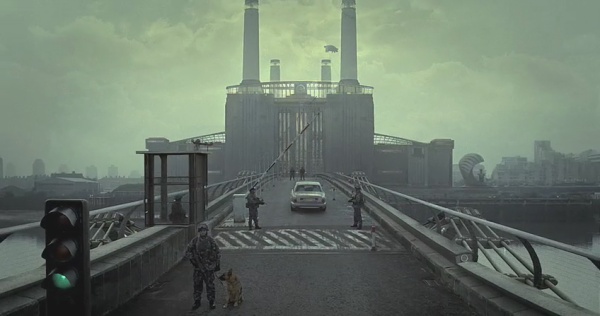
This was my first occasion to revisit Cuarón's despairing-then-hopeful thrill ride since its fumbled theatrical release and more recent best-of-the-decade accolades (the film appeared at #76 in Slant's countdown and claimed Reverse Shot's #19 slot). In retrospect, it's clear why Children of Men—and not the hot-and-bothered arthouse amble Y Tu Mamá También, or the auteurist blockbuster Harry Potter and the Prisoner of Azkaban—is the feature that secured the director's status as the most disciplined and effortlessly engaging of Mexico's big-name film-makers. Four years later, it's not Children's dense science-fiction world-building that most impresses, nor the technical bravado of those one-take action set pieces (especially given that the visceral, immersive impact of a first-time viewing can never be recreated). No, what's astonishing is the simplicity of the thing, despite the stable of screenwriters and the mammoth, textured character of Cuarón's near-future landscape. Compared to the other science-fiction achievements of the past decade, Children of Men is a tightly plotted thing, lacking any of the extraneous elements that so often bog down other entries in the genre. While it may be less thematically ambitious than either WALL•E or Moon, Cuarón film doesn't seem to have a single narrative fumble or pinch of flab. Everything serves its propulsive, harrowing observation of Theo's journey from apathy to heroism, an evolution that Cuarón and leading man Clive Owen make all the more potent by rendering it with perfect naturalism. If Children of Men's Abu Ghraib imagery now seems stale, consider that Arizona's recent enactment of a "Papers, Please" law lends the film's police-state treatment of illegal immigrants—excuse me, "fugees"—a new-found weight. It just goes to prove that a pitch-perfect dystopian fable never loses its relevance.

PostedMay 11, 2010
AuthorAndrew Wyatt
CategoriesDiary
2 CommentsPost a comment
GirlwiththeDragonTattooPoster.jpg

The Girl with the Dragon Tattoo

2009 // Sweden // Niels Arden Oplev // May 1, 2010 // Theatrical Print (Landmark Plaza Frontenac)

B- - The film adaptation of the late Stieg Larsson's phenomenally popular novel, The Girl with the Dragon Tattoo, is a nearly flawless Swedish replica of a lurid Hollywood thriller. Whether that statement represents high praise or a backhand compliment depends on one's regard for lurid Hollywood thrillers, but director Niels Arden Oplev has created, at minimum, a fierce little whodunit that is unwavering in its crackling regard for its heroine. That would be Lisbeth Salander, a misfit hacker with anemic social skills and an eidetic memory, embodied with spooky precision by Noomi Rapace. Oddly alluring and as tightly wound as a feral cat, Rapace is far more compelling than Michael Nyqvist's doughy journalist or the film's convoluted story of a vanished teen. Oplev, to his credit, preserves the novel's righteous anger at misogynistic violence, and also its flair for lending thrilling significance to the tiniest of clues. However, the film's gloomy aesthetic and faux-provocative shocks don't conceal its fundamentally disposable nature. Salander may add some texture to the ranks of fictional female sleuths, but Girl is still just crime, peril, and conspiracy recast as entertainment, a movie-of-the-week seen through a Scandinavian, post-Thomas Harris lens.

PostedMay 3, 2010
AuthorAndrew Wyatt
CategoriesQuick Reviews
3 CommentsPost a comment
TheLosersPoster.jpg

The Losers

2010 // USA // Sylvain White // April 29, 2010 // Theatrical Print (AMC Esquire)

C - Adapted from the comic of the same name by writer Andy Diggle and illustrator Jocks, The Losers suffers from a sloppy sort of faithfulness to its source material's story, motifs, and dialogue. Exaggerated generic elements are essential to the language of the comics medium, but on the screen, The Losers' techno-thriller gobbledygook and melodramatic tropes just seem like the markers of lazy film-making. ("Hey, if we're going to incinerate a bunch of hapless kids, we might as well linger on the charred teddy bear. Y'know, for pathos.") Still, aside from some cringe-worthy racial "humor," there's not much about this A-Team variation that's actively bad. The Losers delivers exactly what one expects of it: wise-cracking Special Forces badasses (and one obligatory hot chick) pulling off hyper-violent heists. It's often fun, occasionally funny, and utterly forgettable. Unfortunately, few of the actors seems to realize just what sort of film they're making here. The exceptions are Jason Patric as spook super-villain Max, who nails the necessary blend of menace and high camp, and to a lesser extent Chris Evans, who's clearly having fun playing a bit against type as a high-strung, motormouth hacker. Ultimately, The Losers is just ninety minutes of stuff blowing up real good.

PostedApril 30, 2010
AuthorAndrew Wyatt
CategoriesQuick Reviews
CommentPost a comment
Ebertfest03.jpg

Dispatches from Ebertfest 2010: Saturday, April 24

Roger Ebert was in attendance at his festival this year. It was the first time that I have been able to see him in person. Cancer has taken his lower jaw, and therefore his voice, but he was still very much a presence at the festival. His populist, humanistic, literate approach to film obviously informs the programming, but it also permeates the spirit of the event. There's a sense of genial adoration towards the guy that is actually a bit disconcerting. No one who attends the festival is there because they dislike Ebert or his taste in film. They're there to bask in an event dedicated to Stuff He Likes. What's fascinating is that now that Ebert is, by his own admission, on the downslope of his remaining years on Earth, his presence at the festival seems to engender joy as much as melancholy. People just love seeing him and knowing that whatever his physical limitations, his enthusiastic cinephilia is the animating force behind the festival.

Whenever Ebert appeared, he seemed to be deliriously good spirits. His frequently threw his iconic thumbs-up gesture, not so much a seal of approval as a generalized cheer-leading pose struck to convey the pleasure of good movies. Chaz Ebert introduced each film, but Roger also offered some words from time to time, using prepared text read by a computerized voice on his laptop. What was truly unexpected was how integral Ebert's physical presence at the podium was for these introductions, and for the festival as a whole.  He could certainly have had someone else read his remarks. Instead, he got up, clicked on the laptop himself, mouthed the words with his now-slack lips, mugged enthusiastically for the audience, and gestured flamboyantly. His lines consistently got the best laughs. It drove home how essential his celebrity is to the festival's pulse, and how his boisterous cinephilia is itself a kind of defiant stance against his physical diminishment.

ICapturetheCastlePoster.jpg

The first screening of the day was Tim Fywell's 2003 coming-of-age feature, I Capture the Castle, based on the novel by Dodie Smith. Ebert pitched it as a family film, but I suspect Castle is bit much for younger kids. It's not the stray bits of nudity (tasteful and humorous) that present a challenge, but the subject matter, which treads on class, madness, violence, virginity, and a thorny romantic melodrama that veers between the subdued and the exaggerated. The real pleasures here are the green, damp locales of the English countryside, and the familiar faces: the captivating Romola Garai (eighteen-year-old Briony in Atonement) as lovelorn narrator Cassandra; Bill Nighy as a writer languishing in poverty and flirting with madness; and a baby-faced Henry Cavill (The Tudors' resident Adonis) as a servant boy seduced by London's pleasures.

VincentaLifeinColorPoster.jpg

The DIY slot this year was filled by Jennifer Burns' 2008 directorial debut, Vincent: A Life in Color. Burns profiles Chicago's "Fashion Man," Vincent P. Falk, who takes it upon himself to entertain river tour boats by dancing on the city's bridges in a seemingly endless collection of shockingly bright suits. Vincent is strictly low-budget, unaffected, human-centered documentary film-making, so naturally it sinks or swims on the strength of its subject. The appealing thing about Vincent is how easily he evolves from a one-note joke to a fascinating figure with a rich history of achievement, tribulation, and tragedy. Burns clearly admires the guy's unflagging spirit, but the film is at its best when it probes deeper than "Do Your Own Thing" bromides and upends our assumptions about disability, celebrity, ego, work, and the urban community.

TruckerPoster.jpg

First time director James Mottern's Trucker hits all the American indie beats: a plot driven by an economic squeeze, battered and tricky human relationships, a pop-drizzled soundtrack, and plenty of dusty gazing into the distance. While the territory is familiar, what Mottern and his performers get spooky-right is the sense of despair that prevails when your expectations for your own life are simple, selfish, and maddeningly thwarted. As a sullen truck driver whose abandoned eleven-year-old son falls back into her life, Michelle Monaghan is called upon to go through one emotional whiplash after another, and acquits herself beautifully. Firefly alum Nathan Fillion brings a witty, warm-hearted appeal to Monaghan's too-eager (married) friend. It was Ebert that correctly discerned Trucker's most potent gesture: It ends at exactly the right moment, a merit more films (and more indies specifically) should endeavor to emulate.

BarflyPoster.jpg

Saturday (and our time at the Festival) ended with Barbet Schroeder's biographical snapshot of Charles Bukowski, Barfly. There's a scuzzy genius to the simplicity of this film, which doesn't have a plot so much as a character arc that circles around right back to where it started. Essentially, what we're treated to is the tale of two serious alcoholics--a battered, limp-haired Mickey Rourke and a waxen Faye Dunaway--who meet in a Los Angeles of endless dive bars and seedy apartments. They then spend nearly every waking hour pursuing a state of perpetual drunkenness. The attraction here is almost entirely due to Bukowski's screenplay, which is deliciously quotable from beginning to end, and Rourke's mesmerizing performance. It's a ridiculously affected role, but so languidly fierce (if such a phrase is applicable anywhere, it's here), you find yourself grinning ear to ear before you realize that the guy you're grinning at is, well, an unrepentant addict. Under Bukowski, Schroeder, and Rourke, alcoholism becomes a font of gutter wisdom, repugnant and undeniable.

PostedApril 26, 2010
AuthorAndrew Wyatt
CategoriesFestivals
1 CommentPost a comment
Ebertfest02.jpg

Dispatches from Ebertfest 2010: Friday, April 23

My wife and I had been batting around the notion of attending Roger Ebert's annual film festival in Champaign, Illinois for a few years, but this was the first year in which we actually had the will and the wherewithal to make the three-hour trek up from St. Louis. Two factors sealed the deal in 2010: 1) Charlie Kaufman was going to be at the festival for a screening of Synecdoche, New York, a film for which I have been enthusiastic evangelist; and 2) Ebert has, of course, been engaged in a remarkably public struggle with cancer, and, frankly, I wanted to see him in person and experience his peculiar cult of personality firsthand while he was still around.

Time off from work is at a premium right now, so the wife and I made plans to attend on Friday and Saturday only, heading up to Champaign on Thursday night. As one might expect, the festival is fairly small in scale. The only screening venue is the Virginia, an 89-year-old downtown theater built in the Italian Renaissance and Spanish Renaissance styles, and now owned by the city's parks district. Given its age, the Virginia has been maintained fairly nicely, although there is apparently plenty of ongoing restoration. The facade of the building is especially gorgeous, with classy touches like the painted relief sculptures above the second-story windows. (The marquee, however, is in rough shape, and could use some attention.) The interior is evidently on the cusp of a round of restoration, and it definitely feels a bit more worn and cheap than the exterior, epitomized by the the acoustic drop ceiling and track lighting in the lobby.

On the upside, the theater has balcony seating--which is rare in St. Louis--and state-of-the-art projection and sound systems, not to mention two vintage projectors capable of showing 70-mm films. The lush auditorium boasts a full, retractable curtain and an elevated stage deep enough to accommodate post-film discussion panels. The seats are adequate, if not the most comfortable. The main problem I had with the seating was the spacing of the rows, which is both very tight and apparently variable from row to row. Long-limbed guy that I am, I quickly tumbled to which rows gave me an extra couple of inches, so that my knees weren't pressing painfully on the seats in front of me. (The festival staff were fairly strict about the no-camera policy in the auditorium. Hence the dearth of photos.n I really didn't want to get bounced on my first day.)

The admittance system for the festival is interesting. Festival pass holders show up very early each day and line up to claim their seat for that day. The staff allows pass holders to "mark" their seat with an article of clothing, program, or other item. This permits them to leave between screenings, and then breeze back in just before the film to reclaim their seat. People with tickets to individual screenings (which was our situation) line up about a half-hour before a film starts, and are let in about fifteen minutes prior, whereupon they scramble for the better seats not already claimed by pass holders. Finally, just before the screening starts, the theater permits people to buy "rush tickets" for all the empty seats in the house (due to pass holders who skip out on that screening, or to absent ticket holders). As you can imagine, getting everyone seated for each screening ends up being a fairly chaotic, laborious process, with the theater repeatedly urging viewers to find their seats and ushers sweeping through to find open spots for the rush ticket holders. It's definitely a system that privileges pass holders; if I ever attend the festival again, I'll likely be putting the money on the barrelhead for a pass.

DepaturesPoster.jpg

Our first screening on Friday was Yôjirô Takita's Depatures, which won the Best-Foreign Language Film Oscar in 2009. It screened briefly in St. Louis last year, but I had missed it. The film tells the story of a young cellist who, hard up for work after his orchestra folds, takes a job in his hometown "encoffining" corpses for cremation. While more comedic and conventionally sentimental than Tokyo Story or Ikiru, Departures is consistent with the melancholy aura and emotionally unabashed character of those those classics, and further bolsters the notion that Japanese film-makers understand better than their peers elsewhere how to use cinema to confront mortality. The film takes some predictable turns in its final act, but I misted up just the same, big squish that I am.

ManwithaMovieCameraPoster.jpg

Next up was Dziga Vertov's 1929 avant-garde silent classic, Man with a Movie Camera, which was screened with a live original soundtrack performed by the three-man Alloy Orchestra. This was a real treat. I had to miss the film when it screened at the Webster Film Series last year, and it's been one of my silent must-sees for a while. What can I say about it that hasn't already been said? It's essentially an eighty-year-old metafilm about modernity and the omnipresence of both the camera eye and the moving picture in our lives. The film has a sense of both progressive triumphalism (befitting its Soviet origins) and disquieting anxiety about it. The pacing is precisely what makes it function so spectacularly well. While so many silent films are glacial and stagey, Man with a Movie Camera is frenetic and defiantly cinematic. It wouldn't have been half as memorable without the live soundtrack, however, which was relentless, thunderous, and even occasionally humorous.

SynecdochePoster.jpg

We finished off Friday night with 2008's Synecdoche, New York, which is the only film we attended that I've previously seen. The appeal, then, was viewing it with Kaufman in the house, as well as Ebert, who has been such a dogged booster for the film. Synecdoche sold out in a couple of hours when tickets went on sale the first week of April, so we lined up for two hours to buy rush tickets. With about forty-five minutes to go, one of the festival volunteers apparently took pity on us as we sat in the drizzle, and offered us her unused passes for Synecdoche only, provided we turned them in at the box office afterward. Needless to say, I couldn't thank her enough. There seemed to be a healthy number of people in attendance who hadn't seen the film before. It garnered a surprising amount of laughter throughout, and a bit of applause in response to "Fuck everybody. Amen." I've said my piece on this remarkable film before. What's amazing is how, despite its reputation as a morbid drag, Synecdoche gets funnier every time I see it. I think I'm the only person who has to stifle a cracked guffaw when Olive responds to Caden's coerced confession and plea for forgiveness with, "No." What does that say about my sense of humor?

PostedApril 25, 2010
AuthorAndrew Wyatt
CategoriesFestivals
1 CommentPost a comment
HowtoTrainYourDragonPoster.jpg

How to Train Your Dragon

The Wyrm and His Boy

2010 // USA // Dean DeBlois and Chris Sanders // April 18, 2010 // 3D Digital Theatrical Projection (Wehrenberg Ronnies Cine)

B+ - For over a decade now, Dreamworks Animation has been churning out Shreks, Madagascars, and various other talking animal mediocrities (anyone remember Shark Tale?), jousting with Blue Sky Studios for a distant second-place slot behind American animation's reigning champion, Pixar. In 2008, Dreamworks managed its first genuinely good film, Kung-Fu Panda, a charming, marvelously designed bit of fluff in the underdog sports movie mold. Lacking contemporary kiddie animation's characteristic risible pop culture references and cheap scatological humor, Panda hinted at better things to come from the studio in terms of feature animation. And, lo and behold, here we are, two years later, and Dreamworks has delivered the exhilarating, dazzling How to Train Your Dragon, a film that should by all rights be nothing more than disposable entertainment, but attains something much finer. No doubt this is at least partly due to the men at the helm, Dean DeBlois and Chris Sanders, who were the minds behind that oddball late Disney Renaissance marvel Lilo & Sitch. However, it's undeniable that Dragon feels like the progeny of a studio that has finally found its stride and resolved to aim high. The story is simple, the design breathtaking, the action rousing, and the humor mostly warm and sweet. While Dragon lacks the grace and thematic sophistication of a Pixar film, it is by any measure a damn splendid animated feature.

Based on the novel by Cressida Cowell and adapted by DeBlois, Sanders, and William Davies, Dragon is a teachable example of how superior children's films flow from simple, vivid stories, as opposed to high concepts or gaggles of wacky characters. At bottom, the film is a winning blend of two familiar fairy tale scenarios: 1) Loser Find His True Purpose, and 2) Two Groups Find Understanding. The setting is Berk, a fantastical Dark Age Nordic village as seen through a sumptuous, sardonic cartoon lens. (Picture Monkey Island creator Ron Gilbert's take on Richard Fleischer's The Vikings and you won't be far off the mark.) The village is bedeviled by constant dragon attacks, and as a result life in the community is organized almost entirely around fighting the beasts. Our hero is a milquetoast blacksmith's apprentice named Hiccup (Jay Baruchel), who wants more than anything to slay a dragon and thereby prove himself, particularly to the aloof object of his crush, Astrid (America Ferrera), and to his perpetually disappointed father, Stoic (Gerard Butler), who is, naturally, both a mighty warrior and the village chieftain.

When an opportunity to kill a wounded dragon falls into Hiccup's lap, the young Viking nonetheless finds himself pitying the creature. Over the course of several days he returns to visit the hobbled dragon, which he dubs Toothless, bringing it food and gradually earning its trust. Hiccup's kindler, gentler approach proves to be a boon, as he quickly rises to the top of his dragon-slaying class with the aid of all the practical knowledge he's gleaning from his quality time with Toothless. Eventually, Hiccup fashions a prosthetic tail fin for his dragon pal, as well as a saddle and bridle, and before you can know it the pair are sailing through the wild blue yonder. This is just about the point when his secret comes out to Astrid, the most capable wannbe-dragon-slayer in the village before Hiccup's unlikely rise. Shortly thereafter, Hiccup's enraged father captures Toothless and uses him to discover the lhidden location of the legendary Dragon's Nest, setting the story up for a climactic confrontation.

Dragon treads over well-traveled fairy tale territory, but it's told with an admirable tidiness and emotional sincerity. There are no feeble, prolonged digressions for the sake of comic relief or unearned pathos. The scenes click together, one after the other, succinctly establishing the story's core emotional conflicts while also taking time to revel in the film's rich design. And what design! Boasting the most evocative art direction in a computer animated feature since 2007's Ratatouille, Dragon is bursting with marvelous sights, evincing a phenomenal attention to detail and a spirited affection for its historical-mythic Nordic setting. From the mighty longboats and icy fjords to the tiny runes scrawled in a dusty book, the film is wall-to-wall with visual pleasures. The design just feels positively enthusiastic, and while one might be tempted to dismiss its "Völsung-Cycle-for-Kidz" aesthetic as faintly ridiculous, the overall effect is so lusciously enveloping and so vividly realized that the look of the thing feels like an artistic achievement all on its own. Nowhere is this element more apparent than in the dragons themselves, for DeBlois and Sanders have envisioned them not as a slew of anonymous scaly terrors, but as a collection of distinctive species, each with its own appearance, movements, personality, and lethal breath weapon. Toothless, who from a certain angle resembles nothing so much as a proud, finicky black cat, is a particularly fine example of a memorable animated creature whose persona is derived almost wholly from facial expressions and motion.

Baruchel—who is apparently a movie star now, but who I still remember best as scrawny, dimwitted Danger from Million Dollar Baby—is a fine fit for the wry, self-effacing, slow-on-the-uptake Hiccup. Indeed, most of the voice-acting is suitably spry and broad without being distracting, with Craig Ferguson's garrulous blacksmith being a particular standout. One of the film's odd incongruities is that the adult Vikings speak in booming Scottish brogues, while the adolescents sound like Santa Clara high school students. (When it is dubbed into Danish or Norwegian, will the Vikings still have Scottish accents? The mind boggles.) The film's rare moments of unsuccessful, grating "humor" consistently involve the teenaged Vikings, who, more so than any of Dragon's other characters, seem to have wandered in from hyper-kinetic afternoon cartoon show. They're cranked up to eleven—as teens are wont to be, I suppose—and therefore seem a poor fit for the film's more conventional storybook pacing and tone.

While How To Train Your Dragon fits in seamlessly with a thousand other good-natured children's stories about understanding and cooperation, DeBlois and Sanders reveal, through their handsomely expressed Long Ago milieu, a more sophisticated dimension to their film, one absorbed with the relationship between man and animal. The dragons of this story possess fantastic physical qualities, but they are not genius arch-villains in the mold of Tolkein's Smaug. They are animals, who yearn for food, comfort, and companionship above all else. Dragon thus functions as a kind of Domestication Myth, condensing millennia of side-by-side adaptation between man and beast into a magical moment when the savage wolf changes into the loyal hound, or the stallion into the steed. It might be a far sight from the psychological, emotional, and generic complexity that Pixar has been able to weave into its ostensible children's stories, but this added dimension to Dragon deepens its appeal and adds a humane resonance to its timeworn outlines.
PostedApril 20, 2010
AuthorAndrew Wyatt
CategoriesReviews
2 CommentsPost a comment
Newer / Older
RT_CRITIC_TM_BADGE.jpg
The Take-Up Podcast

Twin Peaks: The Return

2007 - 2016: A Personal Cinematic Canon

download.png

Recent Posts

Blog
New Reviews at The Take-Up
about 8 years ago
Miles to Go Before I Sleep
about 8 years ago
Delete Your Account: 'Friend Request'
about 8 years ago
Feminine Mystique: 'mother!'
about 8 years ago
Unmuffled Screams and Broken Hearts - 'Twin Peaks: The Return,' Parts 17 and 18
about 8 years ago
Send in the Clown: 'It'
about 8 years ago
Unmuffled Screams and Broken Hearts - Twin Peaks: The Return, Part 16
about 8 years ago
Fetal Infraction: Prevenge
about 8 years ago
You Don’t Know Why, But You’re Dying to Try: The Lure
about 8 years ago
Unmuffled Screams and Broken Hearts - Twin Peaks: The Return, Part 15
about 8 years ago

© 2007 – 2026 Andrew Wyatt