Blog
About
Indices
Films by Title Gateway Cinephile Posts by Date The Take-Up and Other Posts by Date Horror Cinema David Lynch's Shorts John Ford's Silents H. P. Lovecraft Adaptations Twin Peaks: The Return Westworld Freeze Frame Archive
What I Read

Gateway Cinephile

Appreciation and Criticism of Cinema Through Heartland Eyes
Blog
About
Indices
Films by Title Gateway Cinephile Posts by Date The Take-Up and Other Posts by Date Horror Cinema David Lynch's Shorts John Ford's Silents H. P. Lovecraft Adaptations Twin Peaks: The Return Westworld Freeze Frame Archive
What I Read
Beauty and the Beast

Beauty and the Beast

2015 Classic French Film Festival: Beauty and the Beast

[This introduction to Jean Cocteau's Beauty and the Beast was presented on March 13, 2015 at the Webster University Moore Auditorium as a part of the 2015 Classic French Film Festival.]

This is the fourth consecutive year I’ve served as a presenter at the Classic French Film Festival, and for me it is an especially exciting return to the podium. In part this is because Cinema St. Louis has entrusted me with the honor of introducing the festival's opening night feature. And in part it is attributable to the fact that tonight’s film is among the most iconic, influential works of both French-language and fantasy cinema. However, the lion’s share of my enthusiasm stems from the sheer distinction of tonight's feature, Jean Cocteau's 1946 film Beauty and the Beast. It is, in a word, a spellbinding creation.

Although the film was adapted from Marie Leprince de Beaumont's beloved eighteenth-century fairy tale, Cocteau faced an uphill battle in bringing his cinematic version of Beauty and the Beast to life. Filmed in the lean, post-Occupation years of late World War II, the production was troubled by shortages and technical setbacks. Moreover, the landscape of French cinema at the time was dominated by poetic realism, setting Cocteau's film in opposition to the prevailing tastes of filmgoers and critics. If his press notes for the film's American release are any indication, the director was exasperated by the French public's inability to accept Beauty and the Beast on its own terms. As he indicates in the film's preamble, Cocteau's wish was that viewers approach this fairy tale with the absolute receptiveness of a child.

This is not to say that Beauty and the Beast is a puerile or simple-minded work. Indeed, it is a far cry from the sweet story of love triumphant that one might expect. Although twentieth century cinema had a penchant for sanitizing and infantilizing fairy tales in the process of translating them to the screen, Cocteau's approach to the source material is psychologically knotty, erotically charged, and strangely contradictory. 

The broad strokes of this Beauty and the Beast are familiar, such that even today's elementary school set would likely find it comfortable territory. The film is replete with the tropes of medieval literature and folklore, from fey curses to a magic mirror to a pair of vain, wicked sisters just begging for their comeuppance. De Beaumont's original tale is in part a gender inversion of the medieval motif of the 'loathly lady,” a hideous crone who is restored to loveliness by the affections of a noble-hearted suitor. Cocteau's adaptation also features allusions to classical mythology, befitting the director's persistent fascination with such legends in his films, plays, poetry, and designs.

Despite this well-worn lineage, Beauty and Beast continually upends expectations regarding the contours of a neat and tidy fantasy fable. Plot elements are introduced and then quickly forgotten or discarded. The boundaries between the mundane and magical, normally sharply delineated in fairy tales, are uncannily smudged in Cocteau’s telling. The villains wear their hearts on their sleeves, while virtuous Belle remains a conflicted and enigmatic figure to the end. Far from being cowed by the Beast, this Beauty seems to straightaway discern the romantic and sexual power she holds over him. When the Beast is at long last transformed into a beaming prince, Belle's reaction is one of vague disappointment. This was notoriously mirrored by actress Greta Garbo, who allegedly stood up at the conclusion of a screening and demanded, “Give me back my Beast!”

Certainly, the film's lead performances are central to its otherworldly charms. It’s difficult to imagine the feature succeeding so splendidly without the coquettish, luminous presence of Josette Day as Belle, or without Cocteau’s longtime partner and muse Jean Marais as the Beast. Hissing, snarling, and shrieking like a raspy mountain cat from beneath the layers of fur that conceal his chiseled countenance, Marais nonetheless conveys the sense of a profoundly shamed and troubled soul. One can easily understand why the actor regarded it as one of the most challenging and successful roles of his career.

Even absent its leading man and lady, however, the film would still stand as a sumptuous and amazingly tactile realization of the fantastic, a novel stripe of cinematic magic. If tonight is your first encounter with this magnificent work, it is the marvels of the Beast’s enchanted castle that will doubtlessly linger: disembodied arms holding aloft candelabras that ignite on their own accord; statues that exhale smoke and study interlopers with bright, moving eyes; a locked pavilion filled with riches; a living bed and talking door; a glove and necklace ensorcelled with faerie glamour. Through the power of the Beast's magic, tears become jewels and a loyal steed always knows its rider's wishes. To experience these wonders requires only that, as Cocteau entreaties, we set aside our adult cynicism for a short time and say the magic words, “Once Upon a Time…”
PostedMarch 14, 2015
AuthorAndrew Wyatt
CategoriesEssays
Life of Riley

Life of Riley

SLIFF 2014: Life of Riley

Cinephiles often characterize prolific French filmmaker Alain Resnais’ lengthy “late period”—spanning roughly three and a half decades until his death this past March—as an era of formal experimentation. There is merit in this description: Resnais drifted away from the anxious severity of features such as Hiroshima mon amour and Muriel in favor of a disarming playfulness. Beginning in the 1980s, he started toying with the relationships between cinema and other mediums, from operetta to comic strips. Most conspicuously, Resnais adapted several theatrical plays into features, often using them as an opportunity to try out some newfound cinematic technique or stylistic flourish.

Sometimes, however, experiments fizzle. Such is the case with Resnais’ final film, Life of Riley (French: Aimer, boire et chanter), adapted from British playwright Alan Ayckbourn’s play of the same name. Resnais previously directed film versions of Ayckbourn’s Intimate Exchanges and Private Fears in Public Places. In the latter (retitled as Cœurs, or “Hearts”), Resnais unaccountably transforms the writer’s desolate tale of disaffection into a sudsy yet poignant comedy. While disappointingly airy and oddly over-praised by critics, Cœurs at least feels like a good faith attempt to translate a work from stage to cinema. The same can’t be said of Life of Riley, which in many ways plays like Cœurs’ more ungainly, half-assed cousin.

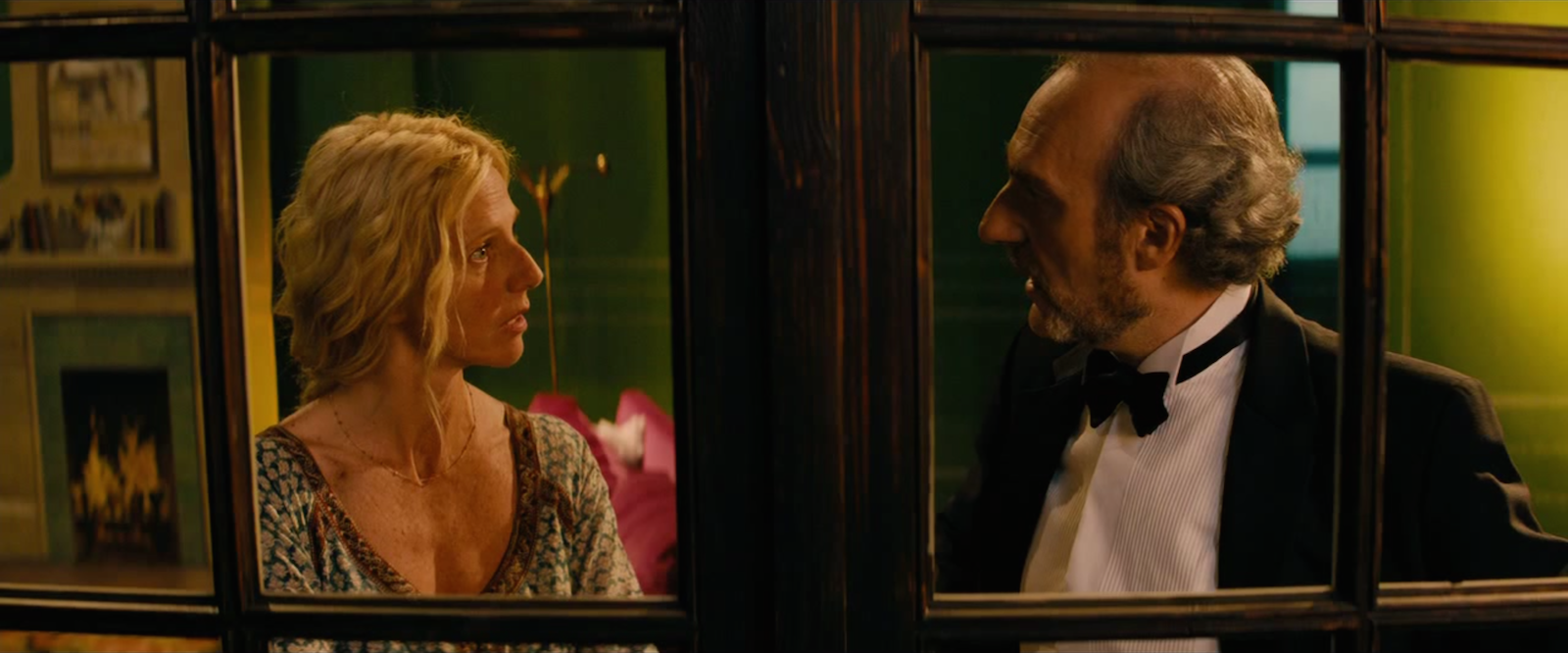
Set in present-day Yorkshire, Riley features a cast of three men and three women, paired off into three male-female couples. Kathryn (Resnais regular Sabine Azéma) and Colin (Hippolyte Girardot) are modestly bourgeois—he's a doctor, she's a dental receptionist—with a row house in Leeds and the free time to perform as amateur actors in a local troupe. Fellow dramatic society members Jack (Michel Vuillermoz) and Tamara (Caroline Sihol) are living lavishly on the latter's self-made fortune, which also supports Tilly, Jack’s teen daughter by a previous marriage. Meanwhile, schoolteacher Monica (Sandrine Kiberlain) has recently fled to the country to live with her older lover Simeon (André Dussollier), a taciturn widower and farmer.

The link between these characters is the eponymous George Riley, who is Monica's ex-husband and a mutual friend of the four wannabe dramatists. The gimmick is that Riley never actually appears onscreen. He is not some cryptic, hovering Godot-like figure, however. He stands astride the film's events, the unseen mover and shaker behind the plot. Inevitably, his name intrudes into every conversation, as the characters are all infatuated with him after a fashion. The screenplay's sly joke is that each person describes a somewhat different impression of the man, who seems to be in the habit of peddling self-serving and contradictory half-truths. As a result, Riley scans as a man-shaped dotted outline rather than an actual character—or, alternatively, as a mirror that reflects each person's weaknesses. The only truism that emerges is that Riley is something of a disingenuous son-of-a-bitch.

The story begins with a bitter revelation: Colin has learned through a colleague that Riley has been diagnosed with terminal cancer, and that he has only months to live (if that). Gathered together to rehearse a new play at Jack and Tamara's luxurious estate, the four friends are shell-shocked by the news of Riley’s illness. Bizarrely, they resolve be to cast their friend in the play, ostensibly to distract him from his grim prognosis with art and camaraderie. Meanwhile, a conflicted Monica attempts to disentangle herself from Simeon so that she can care for Riley during his remaining days, despite the fact that a part of her still loathes her ex-husband. Detailing the plot any further would be superfluous. Everything that follows in Life of Riley is essentially a flurry of posturing, manipulation, and bad judgment emanating from the film's set-up.

On paper, Riley makes for a wry little tale about self-delusion and faux-virtuous narcissism, but Resnais makes some unfortunate choices in the process of bringing it to life. He presents the film in the manner of a shoestring theatrical production, complete with the painted canvas backdrops and chintzy props one might encounter in a community theater filled with preening fifty-somethings. (Hey, just like the play within the film!) It’s an amusing but one-note gag, and while it doesn’t particularly enrich the material, Resnais’ commitment to it hobbles the film in some respects. He and cinematographer Dominique Bouilleret shoot most of Riley in sleepy medium shots. When an extended monologue occurs, the film cuts to a jarring close-up in which the speaker is suspended in a green-screened cartoon limbo. Each scene change is signified by a dissolve to a slapdash illustration of the next setting, in a shot that often lingers awkwardly for far too long. The performances match the film’s style, with the majority of the dialog delivered in a hurried, emphatic manner that would be more fitting for live theater. (Vuillermoz in particular tends to play to the nosebleed seats, to the point where Jack almost seems like a cartoon character.)

Ultimately, Resnais’ efforts to recreate the absurdity of a low-rent theatrical production just seem limp and half-hearted. The “play-as-cinema” conceit isn’t an inherently dubious conceit, of course. The problem is that a lot of blandness lies between, say, the contemptuous Brechtian harshness of Lars von Trier’s Dogville / Manderlay dyad and the ornate unreality of Joe Wright’s Anna Karenina. In contrast, Riley’s conspicuous fakery is just underwhelming, and never amounts to much thematically. A generous viewer could argue that Resnais is highlighting the silly play-acting and flagrant phoniness that are the stuff of human relationships, but that seems a woefully banal subject for such formal effort. Ultimately, the film’s primary effect is to compel the viewer to seek out a polished live production of Life of Riley to witness it in its original form.

PostedDecember 6, 2014
AuthorAndrew Wyatt
CategoriesDiary, SLIFF 2014
New World

New World

SLIFF 2014: New World

[Note: This post contains minor spoilers.]

The underworld war of succession is one of the stock stories of East Asian gangster cinema. Hong Kong director Johnnie To's lyrical and marvelously vicious Election films are the contemporary exemplars of the subgenre, but that certainly hasn't dissuaded other filmmakers from trying their hand at such stories. For New World (Korean: Sin-se-gae), screenwriter-turned-director Hoon-jung Park blends a tale of mob warfare with an undercover cop psychological drama, and the result is an engrossing, tightly plotted thriller.

There's deep cover and then there's deep cover. Officer Ja-sung (Jung-Jae Lee) is in the latter category, having spent nearly a decade infiltrating and then working his way up through the ranks of Goldmoon, the most powerful crime syndicate in Korea. He's managed to position himself as the lieutenant to the organization's heir apparent, Jung Chung (Jung-min Hwang), a swaggering mongoose of a man with all the tastes and self-control of a teenage boy. However, when the group's chairman suddenly dies, the grasping, eerily composed Joong-gu Lee (Sung-woong Park) begins to make a play for the Goldmoon crown, sparking a bloody struggle during the lead-up to the syndicate's election.

As it happens, Ja-sung is on the cusp of leaving the undercover life, but his superior—the rumpled, ruthless Chief Kang (Korean cinema icon Min-sik Choi)—is not about to let his inside man walk away at such a crucial moment. In contrast to many crime thrillers, the police in New World have no grand scheme to take down the syndicate Once and For All. Kang is a realist, and knows that the syndicate can never truly be undone, as a new leader will always rise to fill a power vacuum.  Kang does believe, however, that Ja-sung can nudge the outcome of the election, pushing Jung Chung and Joong-gu Lee into a mutually destructive conflict while handing the throne by default to the group's weak, older vice-chairman. Only three people know of Ja-sung's true loyalties: the police commissioner (Ju Jin-Mo), Chief Kang, and handler Shin Woo (Ji-Hyo Song), whom Ja-sung visits under the pretext of receiving private Go lessons. Such secrecy is for the policeman's safety, but it could also put him in a nasty position if his police confidants were unable to vouch for him.

In this and other respects, New World's plot recalls the acme of the modern “mole” film, the Hong Kong thriller Infernal Affairs (and its American remake, The Departed). What Park's feature does slightly better than either of those films, however, is foreground the characters' psychological anguish, and in particular the undercover protagonist's terror, rage, and moral confusion. Lee proves to be a fine choice for the lead, as the physicality of his acting matches the film's approach. His wiriness and chiseled cheekbones lend him a feline demeanor befitting a mobster clad in Ermenegildo Zegna, but his perpetual frown also gives him a dourness that complements Jung Chung's libertine ways.  Lee is skilled at conveying the anxious weariness of a man who has labored too long at the same high-stress task.  When things begin to go south and his cover is jeopardized, his skin seem to go waxen and onion-thin, and his expressive, darting eyes become the rats that squeal on him.

This isn't to say that New World lacks for more visceral pleasures, such as wince-inducing violence, unexpected narrative swerves, or those moments of pure cinema that have become a standard feature of the East Asian gangster picture. In one jaw-dropping scene, an enormous, hand-to-hand battle royale unfolds in an underground parking garage, where hundreds of goons scuffle in a sea of suits, sunglasses, and flashing knives. Said brawl culminates in a gruesome, sloppy close-quarters elevator showdown that is the antithesis of Captain America: The Winter Soldier's precisely choreographed take on the same.

Overall, however, New World is at its most intriguing and memorable when the action, such as it is, consists of Ja-sung's increasingly desperate attempts to maneuver his way unscathed through a lattice of falsehoods (most of it of his own construction). Indeed, it is a remarkably talky gangster film, full of brooding conversations between allies and harrowing cat-and-mouse games between enemies (Does he know? Does he know I know he knows?). This is hardly a surprising feature, given Park's history as a screenwriter. That pedigree is also apparent in the way that the characters are gradually revealed to be more nuanced than an off-the-cuff assessment might suggest. It's particularly prominent in the case of Jung Chung, whose goofy antics conceal a vicious, amoral cunning, which in turns hides a startling sentimentalism.

New World also has some structural tricks up its sleeve. While the film's events are presented mostly chronologically, Park and editor Se-kyung Moon often toy with the viewer's assumptions about off-screen occurrences. (Rule of Thumb: Don't make inferences about anything that isn't actually shown.) This creates a recurring sensation of sour-gut fearfulness, where characters—and the viewer—become wary of trusting their own instincts.  Ultimately, New World proves to be a nervy, consuming work of character-centered drama, more than earning its 134-minute running time, a rare enough feat in any genre.

PostedNovember 23, 2014
AuthorAndrew Wyatt
CategoriesDiary, SLIFF 2014
The Tribe

The Tribe

SLIFF 2014: The Tribe

It's tempting call the concept behind writer-director Miroslav Slaboshpitsky's The Tribe (Ukrainian: Plemya) a gimmick, but to do so would undersell the feature’s merits as a bold formal and dramatic achievement. The film tells the story of Sergey (Grigoriy Fesenko), the new kid at a Ukrainian boarding school for deaf children and teenagers. Nearly all of the film's characters use Ukrainian Sign Language to communicate, and the few that do not are conveniently muted by barriers or ambient noise. What's more, the film has no subtitles for the benefit of those not conversant in USL, requiring most viewers to puzzle out the non-verbal dialog through close observation of facial expressions, body language, and the context of each scene within the broader narrative. To experience The Tribe is, in essence, to be subjected to 130 minutes of language immersion.

Notwithstanding its characters and setting, The Tribe is emphatically not striving to be an authentic or revealing portrait of Deaf culture. Sergey's tale is an extraordinary one, and (one hopes) not representative of other adolescents' experiences, deaf or hearing, Ukrainian or otherwise.  The film follows Sergey's initiation into an inner circle of older teen boys who stride through the school's halls unfettered by its rules. At night, this clique runs a multifaceted and ruthless criminal operation with the aid of a few staff and faculty. Their underworld enterprises include robbery, drug dealing, and, most significantly for the film's events, the prostitution of a pair of female students. The Tribe thus reveals itself as a rather ugly teen crime picture, as opposed to a mere boarding school soap opera. In fact, the deafness of the characters proves almost incidental to the film's plot. There are only two moments where a character's inability to hear has serious implications, and one of those moments occurs in the film’s final scene.

Ultimately, Slaboshpitsky's choice to present Sergey’s story in sign language has two consequences. First, it illustrates that deaf people are just as capable of greed, lust, violence, and outright foolishness as hearing individuals. It's a banal observation, perhaps, but one that is rarely encountered in a mainstream cinematic landscape that tends to either disregard minority characters or treat them as unwilling emissaries for their entire group. The Tribe's characters are simply people who happen to be deaf, and like all people they can be cruel creatures under the right circumstances.

More significantly, the absence of both spoken dialog and subtitles creates a kind of self-imposed formal challenge for the filmmakers. The characters are blunt, broad individuals presented mostly without backstory, and the film eschews flashbacks, cross-cutting, and convoluted plotting. The focus is on conveying the present moment with as little ambiguity as possible. Slaboshpitsky's style aligns him fairly decisively with the “slow cinema” of contemporary eastern Europe: liberal use ultra-long shots; extended stretches of silence; an absence of non-diegetic music; and a mise-en-scène that can best be described as chilly yet awkwardly intimate. Reconciling this sort of removed, realist aesthetic with the need for narrative clarity is a tricky task, and it's a credit to Slaboshpitsky's skills as both a screenwriter and director that he pulls it off with such supple ease.

By foisting this challenge upon himself, Slaboshpitsky is similarly challenging the viewer to attend closely to each aspect of the film. (Not that one shouldn’t be attending closely to every film, which is one of The Tribe’s many worthy takeaways.) Slaboshpitsky’s feature is, in effect, a lesson in how to watch movies. The importance of composition and editing in cinematic storytelling come into sharp relief as the viewer attempts to riddle out exactly what is occurring within each scene, and how those scenes relate to one another. The film’s sound design is also crucial, for while The Tribe has no spoken dialog, it is far from silent.  It is a film of rumbles, gasps, thuds, giggles, and clatters, a film where the emphatic slap of a signing person’s hands can be as potent as any screeching tire or bellowing monster.

What’s more, the film’s conceit and style provide fascinating opportunities for the performers. By necessity, The Tribe is composed almost entirely of medium and long shots, as close-ups would conceal the actors’ signing and body language. Yet The Tribe is still a film, and a highly naturalistic one at that, where the “big” performance style of the live theater would be a poor fit. The actors must therefore balance the clear expression of meaning with the realist constraints of the production, and they generally do so to fantastic effect. (The one glaring exception is a schoolyard fight where the choreography, such as it is, comes off as laughably phony.) In what will inevitably be one of the film’s most notorious sequences, a sexual transaction between two students unfolds with aloof explicitness, captured in a long single take from a clinical distance. Watching the actress in this scene convey her character’s gradual slippage from bored annoyance to anguished need as she receives the boy’s urgent thrusts, all without saying a word, is a deeply uncomfortable and yet extraordinary experience.

The brilliance of The Tribe is that the extra effort it demands of the audience does not turn the experience of watching the film into an ordeal, like some plate of vegetables to be choked down for one’s own good. It is, in fact, a quite sordid and absorbing tale, full of criminal misbehavior, cold-blooded opportunism, and the ruthless enforcement of tribal boundaries and taboos (as the title suggests).  Slaboshpitsky utilizes the film’s extended shots and yawning silences to establish an atmosphere of persistent dread, in which terrible violence seems to be roiling beneath a brittle layer of mundane monotony. Indeed, The Tribe is especially dismal, as every character seems more venal than the next, Sergey included. He is the protagonist strictly because the film generally follows his viewpoint, and not because he is in any way a conflicted antihero. In truth, Sergey is revealed to be an acutely stupid and dangerous creep, a hot-head who seems capable of almost any depravity given the right motivation. The fact that one cannot look away as he shuffles his way down into damnation is a testament to the extent of Slaboshpitsky’s talents, as well as the dark, elemental allure of a tale where evil turns on evil.

PostedNovember 17, 2014
AuthorAndrew Wyatt
CategoriesDiary, SLIFF 2014
I'm Ten, Then I'll Catch Eleven

I'm Ten, Then I'll Catch Eleven

SLIFF 2014: I'm Ten, Then I'll Catch Eleven

The adjective that most readily comes to mind with respect to Jimbo Yoshimasa's I'm Ten, Then I'll Catch Eleven (Japanese: Boku wa môsugu jûissai ni naru) is "gentle". It is a story about delicate thoughts and emotions, presented in the most delicate way. Which is not to say that it is ephemeral. Yoshimasa's film operates within a mode of marvelously tactile social realism, wherein his camera often assumes the vantage point of ten-year-old protagonist Shogo. In this, the film recalls the work of Korean-American director So-yong Kim, and in particular her poignant tale of childhood disillusionment, Treeless Mountain. Where Kim's features contain an relentless ache of loneliness, however, Yoshimasa's is defined to a significant extent by its warm, sweet tone. Indeed, I'm Ten is practically a conflict-free film, a trait that brings to mind the animated works of Hayao Miyazaki. There are strains and anxieties fluttering through the film's events, which take place over a winter break in Japan, but they are of a profoundly subtle nature. The pleasure of the film lies in watching as Yoshimasa and his performers expertly tease out the story's emotional contours from a relatively sparing screenplay.

Inasmuch as I'm Ten has a plot, it concerns Shogo's wrestling with the Big Questions of morality, life, and death. This plays out through two connected storylines. The first focuses on Shogo's hobby of collecting and mounting insects, a passion passed on to him by his father, who works overseas for long stretches. Just as Shogo is beginning to share this pastime with his eager classmate Kanon, his father returns from the Indian subcontinent with a new outlook on life. He espouses a reverence for all living things, and resolves to give up collecting, lest he pin a beetle that was a human in a past life. This development coincides with a family visit to Shogo's grandfather, whose is so devoted to his deceased wife's spirit that his actions teeter between piety and eccentricity. (His daily routine includes providing her ashes with constant verbal updates on family activities.) These myriad events leave Shogo wondering about the mystery of mortality, and specifically about what constitutes conscientious behavior towards the dead (and the freshly reincarnated).

Despite its subject matter, I'm Ten is not an angst-wracked, funereal sort of film. Shogo is at an age where his response to death is one of modest confusion and curiosity rather than despair. He is concerned foremost with questions about the intersection of the tangible and intangible. Is his grandmother still "there" in the jar of white ash? Is the reincarnated person still "there" in the butterfly that he freezes and mounts? As one might expect in a child, Shogo's response to disorientation is often imitation. When his father becomes vegan, he too quickly and adamantly renounces animal protein. He carefully observes his grandfather's ritualized actions at the household shrine, and later attempts to replicate them. Shogo's mimicry is consistent with the film's ethos, which ultimately favors a fumbling, open-minded approach to life and death, until one finds a set of behaviors that feel respectful and meaningful. It's an outlook that frowns on bullying and smiles on accommodation. No characters in I'm Ten attempt to convert others to their way of thinking, and the tension that arises from differences in belief are of a soft sort that intertwine with other social dynamics. (The mild but very real friction between Shogo's parents over the father's newfound beliefs is conveyed through some masterfully understated acting.) It's a quiet, lovely little film, one that conveys a child's complex and elusive feelings with marvelous nuance.

PostedNovember 15, 2014
AuthorAndrew Wyatt
CategoriesDiary, SLIFF 2014
Big Hero 6

Big Hero 6

Hurrah for Science! Woo! (Part II): Big Hero 6

[Note: This post contains moderate spoilers.]

There’s no getting around the fact that in many respects, Disney Animation’s latest feature, Big Hero 6, is a thoroughly generic kiddie action-comedy. The film’s protagonist, robotics whiz-kid Hiro (Ryan Potter), already has the obligatory dead parents, and by the end of the first act he’s suffered yet another loss. Hungry for revenge, he assembles four fellow science geeks—and one massive but quite huggable battle-bot—into a squad of wannabe superheroes. Do the members of this team have divergent appearances and personalities that nonetheless complement one another? Check. Is there an up-tempo “Putting the Team Together” montage? You bet. How about a climactic battle in which the heroes momentarily lose, only to push through and defeat the unmasked Big Bad through teamwork? Indeed. The tattered tropes come so fast it’s hard to keep track of them all.

That said, Big Hero 6 is still a vivid and novel piece of work. Its positive, even giddy treatment of science is a wholly unexpected delight, for one. Hiro is a scientific prodigy of sorts, a brilliant robotics engineer who graduated from high school at age thirteen. Since then, however, he has slid into rebellious slackerhood, preferring to hustle on the underground robot-fighting circuit rather than waste away in a college lecture hall. Despite his daunting intellect and technical aptitude, Hiro has nothing but scorn for “nerds,” an ambiguously defined class that seems to encompass any STEM types who strive to make the world a better place, or simply takes shameless delight in their discoveries. In short, it includes any fellow science junkies who don’t click with Hiro’s more venal, “too-cool-for-school” attitude.

This doesn’t sit well with his older brother Tadashi (Daniel Henney). After rescuing Hiro (yet again) from a pack of enraged ‘bot fighters, Tadashi shows his little brother around his lab at the San Fransokyo Institute of Technology. Once Hiro gets a close look at the bleeding-edge experimental technology being developed by the other students, he almost unwittingly sheds his blasé demeanor.  It doesn’t even matter that Tadashi’s enthusiastic, socially maladjusted labmates embody the nerd category that Hiro professes to abhor. There’s a new wonder at every turn: a mag-lev cycle designed by industrial engineer GoGo (Jamie Cheung); plasma cutting beams created by applied physicist Wasabi (Damon Wayons, Jr.); and “metal embrittlement” catalysts developed by chemical engineer Honey Lemon (Genesis Rodriguez). Tadashi even shows off his own secret project, in the form of squishy, soft-spoken medical robot Baymax (Scott Adsit). The students’ astounding research and disarming techno-idealism is enough to melt Hiro’s cynicism and ultimately lure him to the Institute.

Later in the film, when Hiro is on his aforementioned path of vengeance against the mysterious Yokai (James Cromwell), he recruits the other Institute students into an ad hoc team of costumed vigilantes. Never mind that none of them are blessed with inherent super powers per se. Big Hero 6's crime-fighters are of the Iron Man persuasion: brilliant but otherwise normal people who use technology to achieve the extraordinary. Hiro's plan is sort of crazy, but Wasabi's objection—”We're nerds!”—has little to do with pragmatism or cowardice. Like Hiro, the lab geeks cling to cultural biases about different approaches to science, and then use circular reasoning to bolster those biases.  Leaving the classroom and research lab behind to battle evildoers just isn't the sort of thing that nerds do, because nerds don't do that sort of thing. Hiro eventually convinces them by appealing to the bonds of friendship, their sense of justice, and their weakness for sheer scientific awesomeness. The latter in particular is a big draw for Institute sports mascot and general hanger-on Fred (T.J. Miller), whose penchant for comic books and monster movies makes him an easy sell for the superteam idea.

The destructive futility of revenge is given a place of prominence in Big Hero 6's thematic landscape, but the film also highlights the importance of rational problem-solving. Baymax's unflappably placid, methodical approach to every challenge provides a humorous manifestation of this ideal, but it's notable that the robot is never portrayed as deficient in other, more emotional respects. If anything, Baymax's caregiver demeanor combined with his logical programming provides him with insight into the psychological dynamics around him. (His concern for Hiro's emotional well-being is the primary reason he acquiesces to the boy's plan to transform him into an armored, jet-powered war-bot.)

Late in the film, Hiro reminds his companions to take a breath and think in order to puzzle their way out of a series of seemingly lethal situations (which they immediately do). His absolute confidence in his teammates' abilities is refreshing, given that victory in so many other kids' films hinges on amorphous concepts such “believing in yourself” or "listening to your heart". In contrast, Hiro urges them: "Use those big brains!" If nothing else, this certainly makes the film distinctive, and perhaps the first Disney animated feature that can be described as Baconian (with a dash of Neil deGrasse Tyson's exuberance). While the film's emotional beats are hardly arid, it's telling that what truly lingers is Big Hero 6's enthusiasm for reason, discovery, and the betterment of life through science. Honey Lemon voices the film's ethos neatly, “I believe the world can be made into a happier, and much brighter place, through the thorough application of nature's toolbox—chemistry!”

PostedNovember 14, 2014
AuthorAndrew Wyatt
CategoriesDiary
Newer / Older
RT_CRITIC_TM_BADGE.jpg
The Take-Up Podcast

Twin Peaks: The Return

2007 - 2016: A Personal Cinematic Canon

download.png

Recent Posts

Blog
New Reviews at The Take-Up
about 8 years ago
Miles to Go Before I Sleep
about 8 years ago
Delete Your Account: 'Friend Request'
about 8 years ago
Feminine Mystique: 'mother!'
about 8 years ago
Unmuffled Screams and Broken Hearts - 'Twin Peaks: The Return,' Parts 17 and 18
about 8 years ago
Send in the Clown: 'It'
about 8 years ago
Unmuffled Screams and Broken Hearts - Twin Peaks: The Return, Part 16
about 8 years ago
Fetal Infraction: Prevenge
about 8 years ago
You Don’t Know Why, But You’re Dying to Try: The Lure
about 8 years ago
Unmuffled Screams and Broken Hearts - Twin Peaks: The Return, Part 15
about 8 years ago

© 2007 – 2026 Andrew Wyatt