Blog
About
Indices
Films by Title Gateway Cinephile Posts by Date The Take-Up and Other Posts by Date Horror Cinema David Lynch's Shorts John Ford's Silents H. P. Lovecraft Adaptations Twin Peaks: The Return Westworld Freeze Frame Archive
What I Read

Gateway Cinephile

Appreciation and Criticism of Cinema Through Heartland Eyes
Blog
About
Indices
Films by Title Gateway Cinephile Posts by Date The Take-Up and Other Posts by Date Horror Cinema David Lynch's Shorts John Ford's Silents H. P. Lovecraft Adaptations Twin Peaks: The Return Westworld Freeze Frame Archive
What I Read
BadTimingGrab01.jpg

Bad Timing

1980 // UK // Nicolas Roeg // May 25, 2010 // Digital Projection (Webster University Moore Auditorium)

[Bad Timing was screened on May 25, 2010 as a part of the Webster University Film Series' retrospective on the early films of Nicolas Roeg.]

[Note: This post contains spoilers.]​

If you have ever harbored a nagging suspicion that there's something a tad creepy about Art Garfunkel, then Bad Timing serves as a resounding confirmation of those qualms. If, however, your conception of the soft-spoken folk musician is bookishly benign, then his presence in Nicolas Roeg's curious film is likely to deliver an uncanny jolt, particularly when Garfunkel's character, psychology professor and profiler Alex Linden, is revealed to be a twisted obsessive and rapist. The most fascinating aspect of Bad Timing is how skillfully Roeg--working from a script by Yale Udoff--essentially achieves a noir bank shot off Garfunkel's public persona, and more generally off of his audience's assumptions vis-à-vis relationships and gender. For roughly the first half of the film, the story seems to be about a meek academic who is used and abused by Milena (Theresa Russell, all thighs and eyes), a self-absorbed party girl and compulsive liar. Then the emotional contours of the tale begin to subtly shift. The jarring, seemingly arbitrary flashbacks that Roeg sprinkles throughout the film start to accumulate into a more truthful picture of Alex and Milena's rotten relationship, and—presto!—the story is actually about a damaged woman who is controlled, stalked, and ultimately assaulted by a sociopath. It's a fake-out, but not an especially galling one. Roeg's disjointed storytelling technique is preoccupied with concealing not the mystery surrounding Milena's drug overdose, but the inevitably violent clash between her negligent personality and Alex's disturbed need to control and possess her. It's not clear there was ever love there, so let's call it a tale of lust gone sour, amplified by Roeg's relentless cutting and peculiar (at times even silly) scoring choices. While it can't hold a candle to Don't Look Now in terms of atmospherics or emotional vigor, it's still nasty, daring stuff.

PostedMay 26, 2010
AuthorAndrew Wyatt
CategoriesDiary
2 CommentsPost a comment
WalkaboutGrab01.jpg

Walkabout

1971 // UK // Nicolas Roeg // May 22, 2010 // Theatrical Print (Webster University Moore Auditorium)

[Walkabout was screened on May 22, 2010 as a part of the Webster University Film Series' retrospective on the early films of Nicolas Roeg.]

The most remarkable thing about Roeg's directorial debut—other than the fact that such an unabashedly poetic and self-assured work could be anyone's directorial debut—is the density of the thing. This is a film that is richly layered with meaning, and yet Roeg achieves such thematic bulk while hewing to an approach that is fairly realistic. Sure, there are heavy-handed cross-cuts, and much gooey lingering on ripe orange sunsets, and narrative digressions that range from the obscure to the weirdly comic. However, there's not much in the film that one could categorize as surrealistic or avant-garde, at least in the mode of Jodorowsky or Lynch (or, for that matter, later Roeg). It's fascinating, then, that there is such ample room for disagreement on what Walkabout is, well, about. There's some embracing and critiquing of cultural myths in there: the ignorant savage, the noble savage, the wilderness as utopia, the wilderness as wasteland. There are obvious themes of colonialism, civilization, and, yes, communication. What resonates strongest for me is the allegory of a sexual awakening (and the fear and confusion it engenders), but this is but one fragment of what makes the film such a compelling experience. Certainly, the closing scenes add a heaping dose of wistfulness, a bittersweet eulogy for those times and places to which we cannot return and are almost certainly idealized in our minds. The thematic correspondence between Roeg's film and Terence Davies' exquisite Of Time and the City is only underlined by their shared quotation (at the end and beginning, respectively) of A.E. Housman's A Shropshire Lad:

Into my heart an air that kills
From yon far country blows:
What are those blue remembered hills,
What spires, what farms are those?
That is the land of lost content,
I see it shining plain,
The happy highways where I went
And cannot come again.
PostedMay 24, 2010
AuthorAndrew Wyatt
CategoriesDiary
CommentPost a comment
HomePoster.jpg

Home

Little House on the Shoulder

2008 // Switzerland - France - Belgium // Ursula Meier // May 19, 2010 // Theatrical Print (Webster University Moore Auditorium)

[Home was featured in a limited engagement on May 14-19, 2010 at the Webster University Film Series.]

B+ - Suffused with both balmy affection and a mounting aura of calamity, Ursula Meier's Home presents an unnerving portrait of a family floundering on the shoals of modernity. The director has described her film as a "road movie in reverse," and that seems as apt a description as any. While the archetypal road movie entails a journey outward to discover something of value, Home concerns itself with a family that has already found everything it needs, only to have its idyllic state disturbed, fractured, and ultimately pulverized by the movements of others. The film's clan—never graced with a surname—dwells in a modest house in the countryside, where an old, unfinished highway runs right through their front yard and has been re-purposed as the family's personal parking lot and street hockey rink. One night, asphalt trucks rumble down the road, and steel barriers spring up along the shoulder and the median. The metaphor is stark: the highway's abrupt completion sends cracks through the family's contented existence, disrupting their physical environment, their well-worn routines, and their interpersonal dynamics. However, Meier steers clear of tussles with central planning bureaucrats, or other Kafkaesque ordeals. Instead, she vividly explores the results of the family's perhaps blinkered determination to stick it out and carry on with their lives. And therein she discovers compelling insights into the fragile nature of domestic happiness and the anxious, bewildering character of contemporary life.

The family of Home is a boisterous nuclear tribe, which middle-aged father Michel (Dardenne veteran Olivier Gourmet) and mother Marthe (Isabelle Huppert) wrangle daily into some semblance of order. They are loving and liberated in the casual manner that only French families seem capable of achieving. Older daughter Judith (Adélaïde Leroux) smokes while bathing in the same tub with her kid brother, Julien (Kacey Mottet Klein), and they splash each other while their parents tease them in the cramped bathroom. Everyone is relaxed, except perhaps for middle daughter Marion (Madeleine Budd), who even in the earliest scenes possesses a simmering anxiousness. Meier and a gaggle of writers leave much unrevealed about the circumstances of the family's move to the country, which occurred years ago. There are hints that it was a shift undertaken by Michel for the benefit of Marthe's mental health, and that this particular house next to the abandoned highway has some obscure quality that puts her at ease. That ease ends, of course, when the road is tarred, striped, and re-opened for the tens of thousands of vehicles that eventually roar past the family's kitchen day and night.

Meier relies upon a lean, disciplined approach to storytelling that favors observation over exposition, where scenes are rigorously explored and yet not drawn out beyond what is necessary to convey a particular character detail or depict a fresh indignity wrought by the highway. There are no significant characters in Home other than the five family members, and each is a victim. Meier relishes devoting time to each, conveying their habits, flaws, and differing responses to their familial crisis, but her creations never betray a self-conscious quirkiness. Judith sunbathes and listens to heavy metal as if nothing has changed; Marion begins obsessing about car counts and pollution-borne illnesses; and Julien turns the highway into his own personal source of amusement. Michel just wants his family to remain happy and safe, but his demeanor betrays doubt. It is Marthe's behavior that seems to shift the most drastically, and not for the better. The highway makes her uneasy and distracted, and the ceaseless noise of passing cars prevents her from sleeping at night. She hallucinates oncoming headlights in the distance, and gazes across the road with a fugue-like vacancy, Meier's camera seeming to anticipate with palpable dread an oblivious, suicidal stroll across four lanes of barreling traffic. Huppert commands our attention with her creased femininity and escalating fearfulness, much as she did in Private Property, another splendid fable of threatened localities and riven family bonds.

Home posits a contemporary world where adaptation is tricky at best, and the resolve and optimism so cherished as virtues by the middle class become proverbial albatrosses. Meier doesn't comment on the fundamental unfairness and cruelty of the family's situation, and the film never suggests that the highway can be defied. It has been channeled past the clan's front door by inscrutable powers, a disruption as uncaring and irresistible as a hailstorm or marching army, but limitless in its duration. Instead of the civic melodrama of a family's struggle against powerful forces, Home presents the mesmerizing collision of human tenacity with a fundamentally untenable situation. The film's central question eventually snaps into focus: How long can the family keep up the pretense that their home is still livable? It's at once enthralling and sickening, as fixed in its outcome as a game of chicken between a man and locomotive, but no less nerve-wracking while it unfolds.

Meier displays an unwavering regard for the urgently personal dimensions of her story as well as an absorption with the willful transformation of environments. This latter impulse risks an ill-fitting element of the grotesque in the film's final act. The contradiction between Marthe's misery and her unwillingness to leave her home forces Michel to take measures that are almost cartoonish in their severity. However, in its closing scenes, Home's somewhat silly gambit—which finds the family sweating inside a sealed habitat, awash in junk and rotting food—pays off cannily as Marthe at last takes her liberation in her own hands. Crucially, the film is not concerned with charting the correct path for those who find themselves trod upon by modern life, but with critiquing the hang-together obduracy that tends to seize families in crisis. Meier suggests that this simplistic ethos threatens to minimize the reservations of some individuals, while lending outsized power to the dysfunctions of others. Ultimately, Home asserts that the longer that mere pluck is substituted for hard-eyed assessment and adjustment, the more traumatic our ultimate dislocation will be.

PostedMay 20, 2010
AuthorAndrew Wyatt
CategoriesReviews
CommentPost a comment
IronMan2Poster.jpg

Iron Man 2

Metal on Metal

2010 // USA // John Favreau // May 16, 2010 // Theatrical Print (Hi-Pointe Theater)

B- - If one regards it primarily as the second chapter in a presumable trilogy of films about billionaire industrialist Tony Stark's super-weapon persona, Iron Man 2 is a slick slice of cinematic entertainment. Director Jon Favreau and leading man Robert Downey, Jr. deliver heaping helpings of the essential vibrancy and wit that rendered the first entry in Marvel's technophilic franchise such a giddy revelation. However, while it functions well enough as a sequel, or as a mere episode in a broader saga, Iron Man 2 is bit soggy when approached on its own merits. Favreau and scripter Justin Theroux—the actor/writer who penned the deliciously acidic Tropic Thunder—are aiming for too many targets in some scenes, while in others they seem to be spinning their wheels in anticipation of the next action set-piece. Accordingly, the film has trouble conveying the sense of nitro-fueled urgency necessary for the Iron Man myth, which is at bottom a Popular Science wet dream with a dash of guilt and ambivalence. The sequel just doesn't hum along so effortlessly as its predecessor, which in retrospect, seems much leaner and more focused, as origin stories often are. Favreau gives us a middle chapter that is preoccupied with mortality, legacies, and thinly veiled allegories about geopolitical blowback and loose nukes. These elements are tackled with aplomb, but cobbled together in such a manner that Iron Man 2 feels a bit haphazard. Eh, no matter. We're all just here for Downey's quips, right?

The new film finds Tony Stark, now exposed as the man behind the crimson-and-gold suit, facing Congressional pressure to turn over his technology to the United States government. The response: "Thanks, but no thanks."  Despite his new-found commitment to world peace, Stark's craving for attention doesn't seem to have diminished one iota, and when he's not jetting off to compete in the Monaco Grand Prix, he's producing an enormous World's Fair-style Expo dedicated to cutting-edge technologies. Meanwhile, a nasty-looking Russian gorilla named Ivan Vanko (Mickey Rourke) labors in secret on a device that suspiciously resembles Iron Man's arc-reactor. (When a heavily tattooed character dwells in a dank apartment with a wall of newspaper clippings about the protagonist, that character is by definition Up to No Good.) Stark has more pressings and visible concerns, however, such as the palladium in his suit's power source that is slowly poisoning him, or his smug ass of a rival, weapons manufacturer Justin Hammer (Sam Rockwell).

In keeping with the first film, Downey is the real draw here, and as expected, he delivers the lighting wit and cocksure demeanor of Stark with swooning precision, even as the sequel grants him more scenes of private grimacing. The film's headiest sequence involves not a robot suit soaring at Mach 3, but a moment of scientific revelation (re-discovery, really), tinged with familial warmth and painted with a whirl of holograms. Downey captures the bliss effortlessly. The cast of characters that Downey played off of so well in Iron Man has returned: Pepper Potts (Gwenyth Paltrow), James Rhodes (Don Cheadle, crisper and cooler than Terrence Howard, but much more believable as an Air Force officer), and even Favreau himself in a more substantial role as chauffeur Happy Hogan. Distracted by his crime-fighting duties, Stark elects to name a flabbergasted Pepper as CEO of Stark Industries. He then brings in a ravishing notary from the legal department, Natalie Rushman (Scarlett Johansson), to act as his new Girl Friday. (Of course, most notaries don't have martial arts training...) Thankfully, Favreau doesn't permit the trite girl-on-girl rivalry angle to blossom into ugly flower, and before the second act both women are butting heads with Stark over his juvenile behavior.

Favreau's penchant for actor improvisation is on fine display here, perhaps even more so than in the previous film, with both Downey and Paltrow acquitting themselves marvelously with their effortless, rapid-fire banter. (Who knew Paltrow had it in her? Not me, certainly.) Rockwell is given free reign to create a thoroughly unlikeable villain, a whiny reflection of Stark who possesses all of his arrogance but none of his confidence. However, the character of Justin Hammer, while he might adhere to the principles of comic book villains, isn't especially menacing. Rockwell is fun to watch, but he merely reveals how genuinely threatening Jeff Bridges was as Obadiah Stane in the first film, even (or especially) when he just wore a business suit. Sadly, Rourke seems a bit wasted here, mumbling out the odd line in a thick Russian accent and seemingly cast for his physical presence more than anything. Johansson is, well, Johansson, gorgeous but ultimately colorless, lending nothing in particular to an underwritten part.

Consistent with the first Iron Man, Favreau here exhibits his remarkable facility for rendering action sequences with clarity and drama, while maintaining the aura of cartoonish thrills that the source material fundamentally demands. Here the "shiny new toy" exhilaration of Stark's outings is still present, but also complicated by the doses of selfish foolishness and strained friendship. There's little need for Dark Knight chills in Favreau's wily, jocular approach, which makes it all the stranger when the director and Theroux nod at graver thematic concerns. In one scene, an amused Vanko asserts that an attack on Iron Man doesn't have to succeed to work: it merely has to put the scent of blood in the water. It's an unsettling notion... until one recalls that Christopher Nolan conveyed far more with a single fearful line from Gary Oldman's Lieutenant Gordon in Batman Begins ("What about escalation?") Still, the result of this dire gesturing isn't so much clumsy as cluttered, as it prevents the sequel from achieving the kind of propulsion that powered the first film's neatly spun tale of a warmonger's redemption. Ultimately, Favreau seems to be demanding too much of his second chapter. He wants to convey the rising global threats that Iron Man's existence engender; conduct a corresponding critique of real-world arms races; warn of the hazards of turning to flawed Randian messiahs; and tackle the unresolved Daddy Issues that plague Stark as his own mortality creeps up on him. Meanwhile, the groundwork for the upcoming Avengers film keeps getting slathered on, which makes for some fun reveals, but diminishes the efficacy of Favreau's proximal story. In this manner, a stirring adventure is made to feel unaccountably like a holding pattern.

PostedMay 17, 2010
AuthorAndrew Wyatt
CategoriesReviews
CommentPost a comment
Kick-AssPoster.jpg

Kick-Ass

Just For One Day

2010 // USA - UK // Matthew Vaughn // May 11, 2010 // Theatrical Print (AMC Esquire)

C - The high concept that undergirds Kick-Ass, while hardly a model of sparkling originality, at least holds the potential for a witty character piece or an intriguing flexing of generic norms. Colorless, clueless high school student and comic aficionado Dave Lizewski (Aaron Johnson) poses what he believes to be a fair question to his fellow geeks: Why has no one ever tried to be a real super hero? The answers seem obvious to Dave's pals. Super-powers don't actually, you know, exist, and even "regular guys" like Bruce Wayne are billionaires with access to science-fiction technology. Any real masked vigilante would end up in traction fairly quickly. Dave will not be deterred, however. Kick-Ass presents itself as a miserablist "What-If?" scenario about a scrawny kid donning a green wetsuit and attempting to fight crime. Unfortunately, the film lacks focus: at times it prefers the mode of a violent comic book played straight, or a limp high school farce, or a deadpan send-up of the superhero genre. Director Matthew Vaughn simply has no notion of where he wants to take this adaptation of Mark Millar and John Romita, Jr.'s comic, and the film's sporadic moments of droll inventiveness don't redeem its awkward muddling of its pedestrian components.

Clearly not having thought his plan through, Dave assumes that all one needs in order to be a superhero is a colorful costume and the will to stand up to evildoers. (One might call this a repurposing of Matt Yglasias' Green Lantern Theory of Geopolitics, which leads us to some kind of strange comic geekery / political blogging ouroboros.) There is a kind of guileless charm to Dave's naïvité, even if Johnson's performance is a clumsy blend of Tobey Maguire's Peter Parker, Cera/Eisenberg discomfiture, and the stammering nerd from a 1980s sex comedy. When Dave assumes his new superhero persona, Kick-Ass, Johnson's physical presence feels more vital, especially in the way his wide blue eyes and slack lips perfectly convey the dim adolescent dork behind the mask. His Travis Bickle mimicry in front of a mirror notwithstanding, Kick-Ass' cracked voice and self-conscious manner hint that Dave's wish-fulfillment will not end well. Indeed, the poor sap's first attempt to confront a pair of thugs lands him in the hospital, with deadened nerves and metal plates bolted to half his bones ("Just like Wolverine!" he enthuses.)

Meanwhile, the film introduces us to middle-aged widower Damon Macready (Nicolas Cage) and his eleven-year-old daughter, Mindy (Chloe Moretz). Like Dave, Damon and Mindy are in the masked vigilante game, but unlike Dave, they actually know what they're doing. Damon is a former hero cop framed by a New York City drug kingpin, now cutting a bloody swathe through the criminal underworld as Big Daddy, assisted by his lethal sidekick Hit Girl. Damon has trained Mindy relentlessly since the age of five to be a walking weapon of mass destruction, and while they are utterly devoted to one another, their father-daughter chats are on the relative merits of automatic pistols rather than the mean girls at school. It's heart-warming, in an utterly twisted and fucked-up kind of way, which I can only assume is one of the primary points of Millar and Romita's comic and, by extension, of Vaughn's film. Namely, that for all the paternal kindliness attributed to the hero-sidekick relationship, there's something more than a tad depraved about schooling a child to be a ruthless killer, especially when it's in the service of your own thirst for revenge.

By pure happenstance and a succession of misunderstandings, Kick-Ass eventually gets tangled up in Big Daddy and Hit Girl's scheme to topple drug lord Frank D'Amico (Mark Strong). Eventually, their efforts draw the attention of D'Amico's witless, slightly spoiled son Chris (Christopher Mintz-Plasse), who has superhero fantasies of his own. It's not worth elaborating on the story any further, because it isn't especially compelling on the whole, or even that thrilling or amusing in its moment-to-moment particulars. There's a subplot about a ridiculously gorgeous girl at school (Lyndsy Fonseca) who befriends Dave but—get this!—mistakenly thinks that he's gay. (Hilarity does not, in fact, ensue.) Vaughn's approach to the film's action is just tired and oddly disengaged, as though it's something he can't wait to get through. And I can't blame him. There's a clinical kind of fascination to the gore-spraying mayhem of Hit Girl's vigilante berserker rages, but the character-centered exchanges between Cage and Moretz are nonetheless far more engaging than the admittedly uncanny sight of a preteen murdering drug dealers with abandon. (Side note: For all of Cage's excesses as an actor, the deliberately bizarre cadence he adopts as Big Daddy is an inspired, genuinely funny flourish and a clever dig at Christian Bale's Batman rasp.)

There's an admittedly cunning little fake-out at the heart of Kick-Ass, in that Vaughn tricks us into believing that his tale is primary about the titular character. Dave's simple character arc from oblivious optimism to disillusionment and back to seasoned optimism occupies much of the film's rather tight thematic space, but narratively speaking, Kick-Ass is actually about Hit Girl. Vaughn is plainly trying to be edgy by centering his plot on a foul-mouthed, bloodthirsty eleven-year-old girl, and the film's probings at comic book conventions aren't entirely off-the-mark. Yet the whole enterprise smacks of trying to have it both ways, of critiquing such conventions as grotesque while also reveling in their sheer awesomeness. Contradiction isn't necessarily a defeating quality for a film. Snyder's underrated Watchmen had its share of problems regarding the simultaneous celebration and revilement of superhero violence, and still managed to be a contemplative and gloriously messy fantasy. Tarantino's superlative Inglourious Basterds was an exquisite snarl of mixed messages, and it even pulled a similar trick, vis-à -vis the gender of its "real" protagonist. However, Vaughn isn't up to the task of juggling his scold and fanboy sides with anything approaching Tarantino's agility, or even achieving Snyder's giddy attention to detail. Kick-Ass simply isn't good enough to accommodate everything that the film-maker wants to achieve. Brutal, bloody violence (borderline torture, really) sits uncomfortably alongside fantastical, bullet-spraying action that bears no resemblance to reality. The casual dismissal of superhero stories as juvenile silliness bumps up against copious gadgetry techno-babble and flamboyant sets. Shoehorning these elements together doesn't make a film complex when it's done so gracelessly, or with so little regard for the coherent whole.

PostedMay 12, 2010
AuthorAndrew Wyatt
CategoriesReviews
CommentPost a comment
PonyoGrab02.jpg

Ponyo

PonyoGrab03.jpg

2008 // Japan // Hayao Miyazaki // May 9, 2010 // Blu-ray - Disney (2010)

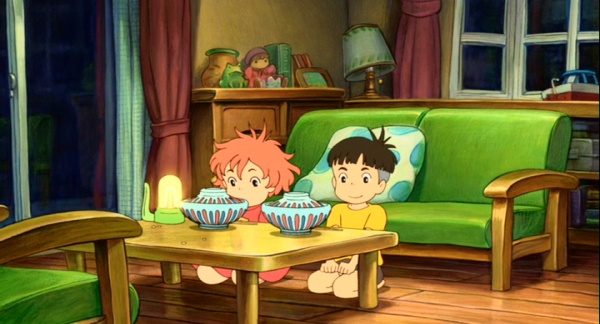
While it possesses neither the unexpected gentleness of My Neighbor Totoro, nor the apprehensive grandeur of Spirited Away, Ponyo surely deserves a position close behind those Miyazaki masterpieces, even if it never attains such perfection itself. Certainly, there are stray elements in this alternately grounded and oneiric fable that never quite fit together comfortably, and the conclusion feels unaccountably limp and vague after all the fretting about a "world out of balance" provoked by our titular fish-girl's giddy escape. On the other hand, Miyazaki's tendency to elide crucial details about his fantasy cosmologies seems far less of a stumbling block here than in his other works, if only because Ponyo privileges unadulterated joy and the subtleties of the parent-child relationship over world-building. Together, Miyazaki's film and Henry Selick's Coraline gave us more thoughtful ruminations on growing up than the rest of the decade's kiddie fare combined. On a second viewing, what's striking about Ponyo from a visual standpoint is the spectrum of drawing styles. Consider the shots above; would you assume that they came from the same film, if it weren't for that conspicuous shock of orange hair? Given how closely Miyazaki himself supposedly labored on the animation, it's hard not to conclude that this diversity is intentional. The cruder, almost doodle-like style seems to predominate when Ponyo is caught in the protean state between goldfish and little girl. The visual approach to Sosuke and a now-human Ponyo at play, meanwhile, invites comparisons to Charles Schultz's precocious tykes, albeit given roundness of form and a richly realized environment as only Miyazaki can.

PostedMay 11, 2010
AuthorAndrew Wyatt
CategoriesDiary
CommentPost a comment
Newer / Older
RT_CRITIC_TM_BADGE.jpg
The Take-Up Podcast

Twin Peaks: The Return

2007 - 2016: A Personal Cinematic Canon

download.png

Recent Posts

Blog
New Reviews at The Take-Up
about 8 years ago
Miles to Go Before I Sleep
about 8 years ago
Delete Your Account: 'Friend Request'
about 8 years ago
Feminine Mystique: 'mother!'
about 8 years ago
Unmuffled Screams and Broken Hearts - 'Twin Peaks: The Return,' Parts 17 and 18
about 8 years ago
Send in the Clown: 'It'
about 8 years ago
Unmuffled Screams and Broken Hearts - Twin Peaks: The Return, Part 16
about 8 years ago
Fetal Infraction: Prevenge
about 8 years ago
You Don’t Know Why, But You’re Dying to Try: The Lure
about 8 years ago
Unmuffled Screams and Broken Hearts - Twin Peaks: The Return, Part 15
about 8 years ago

© 2007 – 2026 Andrew Wyatt